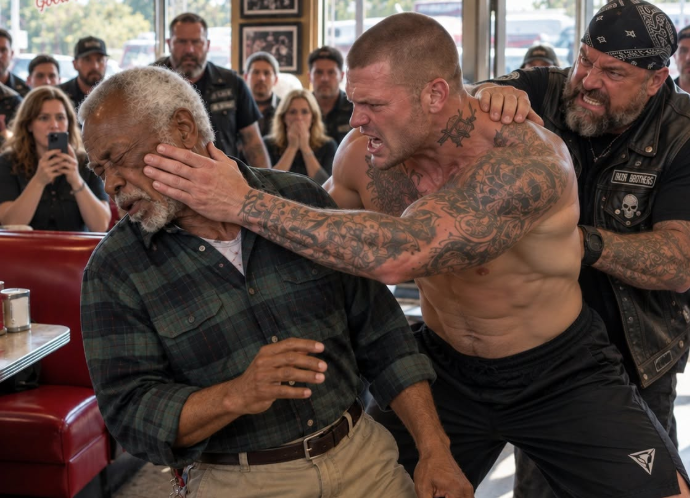
He demanded I give up my booth, mocking my military limp before shattering my coffee cup across the floor !!
PART 2
The word hung in the absolute silence of the diner.
Marcus Reed, a man who looked like he could tear a car door off its hinges, remained on one knee. His massive, scarred hands gently held my trembling fingers.
I looked down at the silver in his beard. It had been nearly thirty years since I first met him in a cold cinderblock visiting room.
Behind Marcus, the heavy glass doors of the diner swung open again, and they kept opening.
The rest of the Iron Wolves began to pour inside. They moved with a disciplined, heavy grace, their thick leather boots thudding against the checkered linoleum floor.
There were dozens of them, filling the narrow aisles and blocking out the morning sunlight.
The diner, usually smelling of frying bacon and old coffee, was suddenly overwhelmed by the scent of hot exhaust, worn leather, and road dust.
They didn’t shout, and they didn’t knock over any chairs. Their absolute silence was far more terrifying than any war cry could have been.
Every single one of them fixed their eyes on me, and then on the shattered porcelain at my feet.
Travis took a slow, clumsy step backward. His expensive leather shoes squeaked sharply against the floor.
The arrogant smirk that had been plastered across his face just moments ago was completely gone. His skin had turned the color of wet chalk.
He was suddenly trapped in a confined room with ninety hardened bikers, and he had just slapped the man their president called Dad.
I felt Marcus’s grip tighten around my hand. The knuckles on his heavy leather gloves stretched white as he stared at the floor.
“Dad,” Marcus whispered again, his voice thicker this time. He slowly lifted his head, and his dark eyes locked onto the swelling redness on my left cheek.
The sorrow in his expression instantly hardened into something entirely different. A cold, dangerous fury radiated from his broad shoulders.
Marcus let go of my hand and placed his boots flat on the linoleum. The heavy leather of his jacket creaked violently as he began to rise.
Behind him, eighty-nine men shifted their weight in unison. The sound of shifting leather and heavy chains echoed off the diner walls.
They were waiting for a single word from their president. They were waiting to tear the diner apart.
I reached out, fighting the painful throb in my bad knee, and placed my hand firmly on Marcus’s shoulder.
“Stand up, Marcus,” I told him, keeping my voice calm and steady. “But do not raise your hands.”
He froze halfway to his feet. The muscles in his thick neck corded with tension, and his jaw locked so hard I thought his teeth might crack.
“He put his hands on you,” Marcus growled, his voice vibrating deep in his chest. “He struck you.”
“And I am still standing,” I replied, squeezing his shoulder. “I do not want anyone fighting over me. That is not why you are here.”
Marcus closed his eyes for a fraction of a second, taking a jagged breath. He obeyed, straightening his massive frame to its full height, but he kept his body angled between me and Travis.
He turned his head slightly, addressing the stunned patrons who were practically holding their breath in the surrounding booths.
“This man is not my biological father,” Marcus said, his deep voice carrying easily across the silent room. “But he is the only father that ever mattered.”
A few of the older bikers near the door nodded slowly. Some lowered their heads, removing their heavy riding glasses.
“Thirty years ago, I was a frightened seventeen-year-old kid,” Marcus continued, his eyes scanning the terrified faces of the diner crowd. “I had lost my mother, abandoned my schooling, and fallen in with people who used me.”
He pointed a thick, scarred finger at his own chest.
“When I was arrested for a foolish, reckless mistake, every single person I thought was my friend turned their backs on me. Everyone walked away.”
Marcus turned his head back toward me, the anger briefly fading into a profound, heavy gratitude.
“Everyone except Walter,” he said softly.
He explained how I had been volunteering with a veterans outreach program back then, trying to help troubled teenagers navigate the juvenile justice system.
He told the room how I had visited him in that bleak detention center every single week, even when he refused to speak to me.
“He brought me books when I threw them at the wall,” Marcus said, his voice echoing over the quiet hum of the refrigerators. “He helped me finish my education while I was locked up.”
I remembered those days clearly. I remembered the rage in a young boy’s eyes, a rage that masked a terrifying vulnerability.
“When I got out, nobody would hire a kid with a record,” Marcus told them. “Walter found me a job at a repair shop. He vouched for me when nobody else would.”
The young waitress standing near the counter slowly lowered the hand covering her mouth. Her eyes were welling with tears.
Marcus looked straight at Travis, who was practically pressing his back against the edge of the next table.
“When I struggled with my anger, Walter taught me what real strength actually looked like,” Marcus said, his voice dropping to a dangerous rumble.
He took one deliberate step toward the wealthy man. Travis flinched, raising his hands instinctively.
“He taught me that strength isn’t measured by how many people fear you,” Marcus said, repeating the exact words I had spoken to him in a greasy garage three decades ago.
“It is measured by how many people feel safe around you,” Marcus finished.
The bikers standing in the aisles murmured their agreement. Over the years, I had helped dozens of them find work, repair broken family ties, and escape destructive lives.
Some of those young men had eventually joined Marcus’s motorcycle club. Under his leadership, the Iron Wolves had transformed from a group of angry riders into a community organization.
They supported veterans, bought groceries for struggling families, and mentored teenagers who needed someone to believe in them.
They called me Dad because I had given them something they had never known before. I had given them a second chance.
Marcus fully squared his shoulders toward Travis. The bikers behind him suddenly grew perfectly still, the kind of stillness that precedes a devastating storm.
For a terrifying moment, everyone in the room expected violence. The elderly couple beside the counter shrank back against the wall.
Travis was shaking visibly now. The expensive watch on his wrist caught the light as his hands trembled.
I stepped forward, putting my small, aching frame directly between Travis and Marcus’s broad chest.
My knee screamed in protest, but I planted my feet firmly on the linoleum. I looked up at the giant I had helped raise.
“If you truly love me, Marcus,” I said, my voice cutting through the heavy tension, “you will remember the lesson I taught you all those years ago.”
Marcus looked down at me, his fists clenching and unclenching at his sides. The protective fury in his eyes was battling with thirty years of respect.
“Nobody deserves to be destroyed for one terrible moment of weakness,” I told him, making sure Travis could hear every single word.
I turned slightly, casting a hard glance over my shoulder at the man who had slapped me.
“But nobody,” I continued, “should be allowed to hurt others without accepting responsibility for their actions.”
Marcus held my gaze for a long time. The entire club waited behind him, watching his hands, waiting for the command.
Slowly, painfully, Marcus took a deep, shuddering breath. He lowered his clenched fists, letting his arms hang loose at his sides.
The collective exhale from the diner patrons was audible. The immediate threat of a brutal beating had passed.
Instead of striking Travis, Marcus turned his head toward the counter. He looked directly at the stunned diner owner, who was clutching a coffee pot like a shield.
“Call the police,” Marcus instructed, his voice entirely devoid of emotion now. “And secure your security footage. Right now.”
The owner nodded frantically, immediately dropping the pot and reaching for the black telephone mounted on the wall.
The other bikers remained nearby, forming a quiet, impenetrable wall of leather and denim around my booth. They were ensuring I was completely safe while the authorities were contacted.
For the first time that morning, Travis looked at me without a trace of arrogance.

He was trapped by his own actions, faced with the overwhelming consequences of his ego, and surrounded by the quiet disappointment of ninety men.
He opened his mouth, perhaps to offer the apology he had violently demanded from me earlier, but no words came out. He struggled to find an excuse that wouldn’t sound pathetic.
I did not pretend the slap had never happened. My cheek was still burning, and the humiliation of hitting the table was still fresh in my mind.
“The most important decision you will make in your life,” I told Travis quietly, “is what you choose to do after this day.”
He stared at me, his eyes wide and completely stripped of his former pride. He finally nodded, a small, defeated motion.
Fifteen minutes later, the flashing blue and red lights of two patrol cars washed over the diner windows, reflecting off the chrome of ninety motorcycles.
The police officers entered cautiously, their hands resting near their belts until they assessed the bizarre scene.
They took statements from the waitress, the owner, and the elderly couple who had witnessed the entire unprovoked assault.
Travis was escorted out through the back door. He didn’t say a single word as the officers read him his rights and dealt with the assault according to the law.
He would have to answer for what he had done, not to a mob of angry bikers, but to the judge in a courtroom.
Once the police had cleared the scene, the waitress nervously approached my booth. She offered me a clean, damp towel with trembling hands.
I accepted it with a gentle smile, pressing the cool cloth against my swollen cheek. “Thank you, sweetheart,” I murmured.
I turned around and addressed the silent room. “Please,” I insisted, raising my voice slightly. “Everyone finish your breakfast. Do not let one cruel act ruin a perfectly good morning.”
The tension finally broke. The low hum of conversation slowly returned to the diner, mixed with the clinking of silverware and the sizzling of the grill.
Marcus walked over to the counter and pulled a thick leather wallet from his vest. He ordered breakfast for all ninety bikers.
The small diner was instantly transformed. The waitresses scrambled to push tables together, laughing as the massive men squeezed into the booths.
It became the warmest, loudest gathering the small town had seen in years. The air filled with deep laughter and the smell of fresh pancakes.
The waitress brought me a fresh cup of black coffee, carefully placing it on a clean saucer. She refused to take the dollar bill I offered her.
Marcus quietly paid the massive bill for every single meal. He also left a thick stack of bills on the counter to help the owner replace the broken dishes and cover the disruption.
Before leaving, the bikers began to line up near my booth. It was a procession of giants, each one waiting their turn.
One by one, they approached me. Some offered a firm, respectful handshake. Others pulled me into gentle, bone-crushing embraces.
“Thank you for getting me out of that basement, Dad,” a man with a scarred cheek whispered as he hugged me.
“My daughter starts college next week,” another biker told me, shaking my hand fiercely. “Because you taught me how to stay sober.”
Others didn’t say much at all. They simply called me Dad, tipped their heads, and walked out into the bright morning sun.
My eyes filled with hot tears as I looked around the crowded, joyful room. I wiped them away with the back of my hand.
Since my wife passed, I had spent years believing that my quiet life had simply grown smaller with age. I thought my legacy was just a fading memory.
Yet, sitting in that diner booth, I discovered something incredible. The quiet kindness I had given away decades ago had built an absolute fortress.
It had built a family far larger, and far stronger, than I could have ever possibly imagined.
I took a slow sip of my coffee, feeling the warmth spread through my chest as the roar of ninety motorcycle engines fired up outside.
I had entered the diner expecting nothing more than two eggs and a quiet morning.
I was leaving with the absolute certainty that a good heart leaves a much greater legacy than money, power, or fear ever could.
Because true family is not always the people who happen to share your blood.
Sometimes, family is the people who remember your kindness, who return when you need them most, and who stand firmly beside you when the whole world looks away.
The roar of the ninety motorcycles finally faded into the distance, leaving the diner in a stunned but comfortable silence. The owner, a man named George who had worked behind that counter for twenty years, slowly walked over to my booth.
He carried a fresh pot of coffee, his hands still shaking slightly as he poured the steaming dark liquid into my cup. He didn’t say a word at first, just staring at the space where Marcus had been kneeling minutes before.
“I’ve known you for a long time, Walter,” George finally said, wiping his hands on his grease-stained apron. “You never mentioned you had an army looking out for you.”
I took a sip of the hot coffee, letting the familiar bitter taste ground me. “They aren’t an army, George,” I replied quietly.
“They are just boys who needed a little direction,” I added, looking out the window at the empty parking lot. “Boys who grew up and decided to pay it forward.”
George shook his head in absolute disbelief, picking up the pieces of the shattered porcelain cup from the floor. He insisted that I wouldn’t pay for a single meal in his diner for the rest of my life.
A few minutes later, the young waitress who had been terrified during the confrontation approached my table. Her name was Emily, and she was working her way through nursing school.
She placed a large slice of warm cherry pie in front of me. She didn’t ask if I wanted it; she just set it down with a gentle, appreciative smile.
“I thought that man was going to seriously hurt you, Walter,” Emily whispered, her voice still trembling. “I was so scared, but you didn’t even flinch.”
I looked at the young woman, seeing the genuine concern in her tired eyes. “When you survive a war, Emily, a loudmouth in a diner doesn’t seem quite so terrifying.”
I thanked her for the pie and told her to focus on her studies, assuring her that the worst part of the morning was already over. But for Travis, the worst part was just beginning.
Across town, at the local police precinct, the heavy steel door of a holding cell clanged shut. Travis flinched at the sound, the reality of his situation finally piercing his immense ego.
Officer Reynolds, a veteran cop with twenty years on the force, stood on the other side of the bars. He held a clipboard, looking at Travis with undisguised contempt.
“I want my lawyer,” Travis demanded, grabbing the iron bars. “You can’t keep me in here over a minor misunderstanding in a diner.”
“It wasn’t a misunderstanding,” Officer Reynolds corrected him sharply. “You assaulted an eighty-year-old military veteran in front of twenty witnesses.”
Travis tried to pull out his wallet, realizing too late that the booking officer had already confiscated his expensive designer watch and his cash. He was completely stripped of his usual leverage.
“I can pay whatever fine there is,” Travis insisted, his voice rising in panic. “I have money. This is ridiculous.”
Officer Reynolds stepped closer to the bars, his expression hardening. He lowered his voice, making sure every word hit exactly as intended.
“Your money means absolutely nothing in this building,” Reynolds told him. “That old man you slapped? He helped my younger brother get off the streets fifteen years ago.”
Travis stepped back, his face draining of color. He was beginning to realize that he hadn’t just attacked a random old man; he had attacked a pillar of the community.
“Walter Hayes is a hero to half the people in this town,” Reynolds continued relentlessly. “And the judge who will be seeing you at your arraignment tomorrow? Walter helped his nephew, too.”
The crushing weight of consequence finally settled onto Travis’s shoulders. He sat down heavily on the rigid metal bench, putting his head in his hands as the officer walked away.
He was facing felony assault charges on a senior citizen. His wealth and his arrogant attitude were completely powerless against the absolute loyalty Walter had earned over decades of quiet service.
Meanwhile, back at the Iron Wolves clubhouse on the edge of town, Marcus stood before his men. The massive warehouse was filled with the smell of motor oil and old leather.
Ninety bikers stood in a wide circle around their president. The anger from the diner had subsided, replaced by a fierce, undeniable pride in the man who had brought them together.
“Today was a test,” Marcus told his brothers, his deep voice carrying easily to the back of the room. “A test of everything Dad taught us when we were at our worst.”
He paced the center of the circle, looking at the scarred faces of men who had once been broken, angry teenagers.
“We could have torn that diner apart,” Marcus admitted, his heavy boots echoing on the concrete. “We could have destroyed that arrogant fool and left him bleeding in the parking lot.”
He stopped, raising his scarred fist. “But if we had done that, we would have broken the very first lesson Dad ever gave us.”
A low murmur of agreement rippled through the crowd of bikers. They understood the gravity of the restraint they had shown.
“He taught us that violence is a failure of control,” Marcus reminded them. “He taught us that protecting the weak doesn’t mean becoming the monster.”
Marcus looked at a younger member who had only recently joined the club after struggling with addiction. The young man stood tall, wearing his leather vest with pride.
“We protected him today without throwing a single punch,” Marcus said, his voice thick with emotion. “We showed that coward what real, disciplined strength looks like.”
The warehouse erupted in cheers. It was a chaotic, deafening sound of brotherhood, a validation of the second chances they had all fought so hard to earn.
Later that afternoon, the sun began to set, casting long golden shadows across my quiet suburban street. I sat on my front porch, resting my aching knee on a wooden stool.
The swelling on my cheek had gone down, leaving only a dull, throbbing bruise. I held a framed photograph of my late wife, tracing the edge of the glass with my thumb.
“You would have been proud of them today, Sarah,” I whispered to the empty porch. “They didn’t lose their tempers. They remembered.”
My quiet evening was interrupted by the sound of a heavy engine turning onto my street. I looked up to see a single black motorcycle pulling into my driveway.
It was Marcus. He parked the bike carefully, cutting the engine, and walked up the front steps carrying a small, flat cardboard box.
He didn’t knock. He simply sat down on the wooden porch steps beside me, stretching his massive legs out toward the lawn.
“George sent this over,” Marcus said, handing me the box. “He said you left before he could give you the rest of that cherry pie.”
I smiled, taking the box and setting it on the small table next to my rocking chair. “Thank you, Marcus. For the pie, and for this morning.”
Marcus looked out at the quiet street, rubbing a hand over his silver beard. He looked exhausted, the adrenaline of the morning finally wearing off.
“I almost lost it, Dad,” Marcus admitted softly, refusing to look me in the eye. “When I saw that mark on your face, I wanted to end him.”
I reached over and gripped his heavy shoulder. The leather of his jacket was cool against my skin.
“But you didn’t,” I reminded him firmly. “You felt the anger, and you chose not to let it control you. That is the victory.”
Marcus finally looked at me, the harsh lines of his face softening in the fading evening light. The fierce biker president was once again just a grateful son.
“He’s being held without bail until tomorrow,” Marcus told me, relaying the information he had gathered. “They aren’t going easy on him. The whole town knows what happened.”
I nodded slowly, accepting the news without a sense of triumph. I took no joy in seeing a man ruined, even one as cruel as Travis.
“Justice will run its course,” I said quietly. “He will learn that arrogance has a very steep price. But that is out of our hands now.”
We sat in comfortable silence for a long time as the streetlights flickered on. The crickets began to chirp in the tall grass near the porch.
“The club is organizing a charity ride next weekend,” Marcus mentioned casually, breaking the silence. “We’re raising money for the downtown youth center.”
I smiled proudly in the darkness. “I think that is a wonderful idea, Marcus. Make sure you swing by the diner on your route.”
“Only if you promise to be sitting in the window booth,” Marcus replied with a low chuckle. “We won’t ride without our good luck charm.”
I assured him I would be exactly where I always was. He eventually stood up, brushing the dust from his jeans, and walked back down to his motorcycle.
He paused before starting the engine, looking back at me sitting on the porch. He didn’t say goodbye. He just offered a sharp, respectful salute.
I returned the salute, watching as he rode off into the night. The sound of his engine faded, leaving my quiet street peaceful once again.
The next morning, the local newspaper carried a small story on the third page. Someone in the diner had recorded the bikers arriving, and the video had spread quickly through the town.
The headline read: “Local Veteran Defended by Unlikely Heroes.” It detailed the unprovoked attack and the incredible show of restraint by the motorcycle club.
By the time I arrived at George’s diner the following Thursday, things had noticeably changed. The parking lot was full, but people were lingering outside, talking and laughing.
When I pushed the heavy glass doors open, the bell chimed as usual. But this time, every head in the diner turned toward the entrance.
A sudden, spontaneous round of applause broke out. It started at the counter and spread through the booths until the entire room was clapping.
I stood frozen in the doorway, my face burning with unexpected embarrassment. I gripped my cane tightly, completely unsure of what to do.
George walked out from behind the counter, wiping his hands on his apron. He had a massive grin on his face as he gestured toward the window booth.
“Your table is waiting, Walter,” George called out over the applause. “And it will always be waiting.”
I slowly made my way to the booth, nodding awkwardly to the patrons who reached out to shake my hand or pat my shoulder as I passed.
Emily, the nursing student, practically sprinted to my table with a fresh pot of black coffee. She filled my cup before I even sat down.
“Two eggs, over easy?” she asked, her smile brighter than it had been all week. “On the house, of course.”
I sighed, knowing I couldn’t fight George on the bill today. “Thank you, Emily. That sounds perfect.”
I sat in the quiet morning sun, sipping my coffee and watching the cars pass by on the road outside. I realized that the diner felt entirely different now.
It wasn’t just a place to get breakfast anymore. It had become a monument to something much larger, a testament to the quiet power of community and respect.
Over the next few weeks, the youth center saw a massive influx of donations. The Iron Wolves’ charity ride had raised more money in a single day than the center usually saw in a year.
Travis eventually faced his judge. He lost his lucrative job due to the public backlash and was sentenced to hundreds of hours of community service, working directly with the veterans’ outreach program.
He spent his weekends sweeping floors and serving meals to men who had sacrificed everything for their country. The arrogance was completely stripped from him, replaced by a forced, bitter humility.
I never went to see him work. I didn’t need to gloat or demand a belated apology. My focus remained exactly where it had always been.
I continued my Thursday morning routine. I drank my black coffee, tipped Emily generously, and watched the world go by from my window booth.
But I was never truly alone anymore. Every now and then, a massive motorcycle would pull into the lot, and a leather-clad giant would slide into the booth across from me.
They would order coffee, ask about my knee, and tell me about their new jobs, their kids, or their struggles to stay on the right path.
I would listen, offering whatever quiet advice I could, just like I had done in those cold detention centers thirty years ago.
The work was never truly finished. There was always another troubled kid, another broken life that needed a steady hand and a second chance.
But looking at the men the Iron Wolves had become, I knew that the effort was worth it. Every long conversation, every moment of patience had built something unbreakable.
I was just an eighty-year-old veteran with a bad leg and a fading jacket. But in that small town, surrounded by the family I had built, I was the richest man in the world.