The Hidden Legacy Behind the 0.88-Second Draw: How My Retired-Detective Stepfather’s Eleven-Year Campaign of Petty Lies and Professional Sabotage Unraveled Before His Lifelong Friends, Exposing a Forged Internal Review, Clearing My Military Police Instructor Record Forever, Healing My Mother’s Long Blindness, and Propelling Me to the Federal Training Academy He Never Could Reach on His Own Terms Despite All His Boastful Arrogance and Contempt !!
Chapter 1
“You Must Be Cheating!” My Retired-Detective Stepfather Said When My Average Came Up 0.88 Seconds. He’d Spent Eleven Years Mocking My Job as an Army Military Police Instructor. I Repeated the Challenge, Got the Same Result, and Watched the Range Owner Suddenly Reach for His Phone…
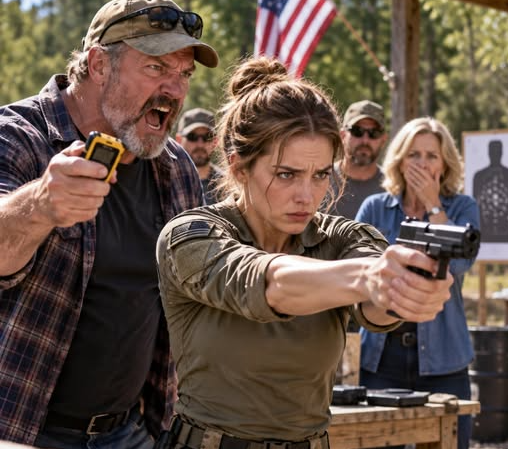
“Take the damn gun, Willa,” Dennis barked, shoving the cold polymer frame of his custom Glock 19 so hard into my chest I had to step back to keep my balance. The gravel of the makeshift backyard range crunched under my combat boots. He didn’t back up. He stood inches from my face, breathing a mix of cheap domestic beer and pure, unadulterated ego.
“Come on, ‘Sergeant,'” he sneered, using mock air quotes. “Show us what your little Army MP desk job taught you. Or do they only issue you guys pepper spray and a clipboard?”
My name is Willa Sutter. I’m a Sergeant First Class in the United States Army. But to Dennis—a man who spent twenty-six years as a city patrol cop and detective before retiring to a life of tactical cargo pants and endless self-glorification—I was just his wife’s disappointing kid who played traffic cop in camo. For eleven straight years, he had belittled my service. Today, at his annual Fourth of July range day, surrounded by a peanut gallery of his ex-cop buddies, he wanted to humiliate me.
“Dennis, back off,” my mother pleaded from the picnic table, looking nervously at the holstered weapons on everyone’s hips.
“No, Martha! She’s always talking about her deployments. Let’s see it,” Dennis snapped, jabbing a thick, calloused finger into my shoulder. “Five rounds. Quick draw from concealment. I just ran a 1.4-second average. Let’s see what a glorified gate guard can do against a real clock.”
I looked down at the yellow shot timer in his other hand. I didn’t want to do this. The most important skill I’d learned in the military wasn’t how to pull a trigger, but when not to. But his hand was still gripping my shoulder, his fingers digging painfully into my collarbone.
“Get your hand off me,” I said, my voice low and dead calm.
He smirked, letting go and stepping back with his arms raised in mock surrender. “Ooh, the desk clerk has some fire. Line up.”
I stepped to the firing line. The summer air was thick with humidity and the metallic tang of spent brass. I cleared my mind, letting the noise of Dennis’s laughing buddies fade into dead static. I secured the Glock in the holster on my hip. I didn’t look at the paper silhouette fifteen yards away. I saw through it.
“Standby,” Dennis mocked, holding the timer right next to my ear to rattle me. BEEP.
My hand moved before the sound even registered in my brain. Sweep the garment. Grip. Draw. Press out. Front sight, squeeze.
BANG.
The explosive crack echoed through the dense trees. I holstered immediately, keeping my eyes locked downrange.
Dennis scoffed, looking down at the timer. Instantly, his face went entirely blank. The blood drained from his cheeks.
“What is it, Den?” one of his buddies yelled.
Dennis hit the button again, his thumb shaking slightly. “Timer glitched. Must have registered an echo off the berm. Run it again.”
“It didn’t glitch,” I said.
“I said run it again!” he roared, slamming his heavy hand onto my back, practically shoving me toward the firing line.
I whipped around, slapping his arm away, my eyes locking onto his. “Do not touch me while I am operating a firearm. Ever.” I faced the target again.
BEEP.
Sweep, grip, press, fire. BANG.
He stared at the digital screen. “Zero point eight seven,” he whispered, his voice trembling. “That’s… that’s physically impossible for you.”
“Average of 0.88,” I replied coldly, ejecting the magazine. “Are we done?”
Suddenly, heavy footsteps crunched on the gravel behind us. A towering man in a battered denim jacket pushed through Dennis’s crowd of friends. It was Ray, the owner of the commercial shooting property next door, who had come over to borrow some tools.
Ray didn’t look at Dennis. He walked straight up to me, his eyes locked onto my holster, then up to my face. He studied the way I stood, the way my hands naturally rested at the ready.
“I know you,” Ray said, his voice slicing through the tense, heavy silence. “I know exactly who you are.”
Dennis sneered, stepping aggressively between us. “Yeah, she’s my stepkid. She’s a military police paper-pusher who just got lucky with a broken clock.”
Ray slowly turned his head to look at Dennis, a look of profound disgust washing over his weathered face. “Shut your mouth, Dennis. You have absolutely no idea who you’re standing next to, do you?”
PART 2: Ray stepped closer to the firing line, his weathered face turning pale. He looked at me again, then at the timer trembling in Dennis’s hand. “Tell me something, Willa,” he said quietly. “Are you still teaching advanced close-quarters weapons retention at Fort Liberty?”
Dennis’s smirk vanished. One of his former police buddies lowered his beer, suddenly interested in the conversation. My mother stood frozen beside the picnic table, her fingers clutching the edge so tightly her knuckles turned white. I simply nodded. “Among other things, yes.”
Ray let out a slow breath. “Dennis, do you remember the federal training conference in Virginia six years ago? The one where a military instructor demonstrated a live-fire response so fast that half the room thought the timing equipment was broken?” Dennis frowned, trying to place the memory. Then Ray said my name, and the retired detective stopped breathing for a second.
“That was her,” Ray continued. “I was there as a civilian range safety consultant. I watched her run the demonstration, and I watched three senior instructors ask her to teach their teams afterward.” He pointed at the timer. “That 0.88-second result isn’t magic, and it certainly isn’t impossible. It’s the product of years of disciplined training.”
Dennis forced a laugh, but it sounded painfully thin. “So she attended some conference. Big deal. That doesn’t make her better than a real cop.” Ray’s expression hardened. “Nobody said it did. But you just spent twenty minutes calling a professional instructor a glorified gate guard because you couldn’t imagine that she might know something you don’t.”
I removed my hearing protection and placed it carefully on the bench. “Dennis, I’ve spent eleven years listening to you explain my own profession to me. Every holiday, every family dinner, every time Mom asked about my work, you found a way to turn it into a joke.” My voice never rose, which somehow made the silence around us even heavier.
Then Ray glanced toward the small office beside the range. “There’s something else you should know, Willa. Your name came up last month when I received a call about an upcoming instructor evaluation. They were looking for someone with your qualifications.” He paused, watching Dennis closely. “And the person who recommended you wasn’t a soldier. It was a retired federal investigator who witnessed your work firsthand.”
Dennis’s face changed again when Ray mentioned the investigator’s name. His buddies exchanged uncomfortable looks, and my mother whispered, “Dennis, what is it?” He didn’t answer. Instead, he pulled his phone from his pocket and stared at the screen as if he suddenly remembered a conversation he’d spent years trying to forget.
Ray reached into his jacket and took out his own phone. “There’s a reason I recognized you immediately,” he told me. “And there’s a reason Dennis looks terrified right now. Eleven years ago, a report was filed that changed both your careers in ways neither of you fully understood.” He unlocked his phone and turned the screen toward me. The first line made my stomach tighten.
PART 3: The first line on Ray’s phone read: “Incident Review — Unauthorized Disclosure and Misrepresentation of Military Training Credentials.” Beneath it was a date from eleven years earlier, the same year Dennis had begun mocking my decision to become an Army military police instructor. I stared at the screen, trying to understand why a report connected to my career would be in the hands of a civilian range owner. Then I noticed Dennis’s name listed among the witnesses. Suddenly, the man who had spent years calling me incompetent looked like someone desperately hoping the past would remain buried.
“What is that?” my mother asked, stepping away from the picnic table. Dennis immediately reached for Ray’s phone, but Ray pulled it back. “You’ve had eleven years to explain yourself,” Ray said sharply. “Perhaps today is finally the day you tell the truth.” Dennis laughed nervously and claimed the document had nothing to do with me. But his eyes kept darting toward the screen, and every person standing nearby noticed.
I took a slow breath and asked Ray to explain. He told us that years ago, a training exercise had been reviewed after someone questioned the accuracy of an instructor’s performance report. My name appeared in the investigation because I had provided a detailed account of what happened during the exercise. The report had eventually cleared me of wrongdoing, but it also documented concerns about statements made by an outside witness. Ray turned the screen slightly, revealing the signature at the bottom of the page.
It belonged to Dennis.
My mother covered her mouth. “You told me you barely knew anything about her military work,” she whispered. Dennis snapped that the report was being taken out of context, insisting he had only answered a few questions when an investigator contacted him. Yet Ray explained that the document recorded something more serious: Dennis had repeatedly questioned my qualifications without ever reviewing my actual training record. His statements had been challenged by verified evaluations and testimony from several military personnel.
For eleven years, Dennis had used his old detective badge, his war stories from the streets, and his loud opinions to make everyone believe he understood my job better than I did. He had told relatives that I spent my days checking identification cards and writing minor incident reports. He had even joked that my uniform was little more than an expensive costume. Now his own signature sat beside a record showing that he had made claims about my professional competence without evidence.
“Why would you do that?” my mother asked, her voice breaking. Dennis looked at her, then at me, but no explanation came. Finally, he muttered that he had never believed the Army could teach someone as much as years on the street. I shook my head. “You didn’t need to understand my job, Dennis. You only needed to respect that it was mine.” For the first time that afternoon, he had nothing clever to say.
Ray put his phone away and explained that the upcoming instructor evaluation was a legitimate opportunity, not a secret promotion or a special favor. My performance would be judged through official procedures, just like everyone else’s. He had recognized me because he remembered the professionalism I had demonstrated years earlier, not because I was someone to be feared. That distinction mattered to me more than Dennis’s embarrassment ever could.
I unloaded my equipment under the range’s established safety procedures and stepped away from the firing line. I had no desire to turn a family gathering into another competition, and I certainly wasn’t going to let Dennis’s reaction define my career. The timer still displayed the results from our two runs, both consistent with what I had recorded. His friends stood quietly, no longer laughing, while my mother approached me with tears in her eyes.
“Willa, I’m sorry,” she whispered. “I should have stopped him years ago.” I took her hand, knowing that an apology could begin a conversation but couldn’t erase eleven years of humiliation. As for Dennis, he remained beside the bench, staring at the timer he had once held up like a trophy. He had challenged me because he expected an easy victory, but what he discovered was that the daughter he had underestimated never needed his approval to become the professional she was.
And as we prepared to leave, Ray received one final message that made him stop beside his truck. He read it twice before looking directly at me. “Willa, the evaluation board wants to speak with you tomorrow,” he said. “Apparently, someone has submitted additional documentation about that old report.” I watched Dennis turn toward us, his expression suddenly unreadable, and realized that the truth behind those eleven years might not have been fully revealed yet.