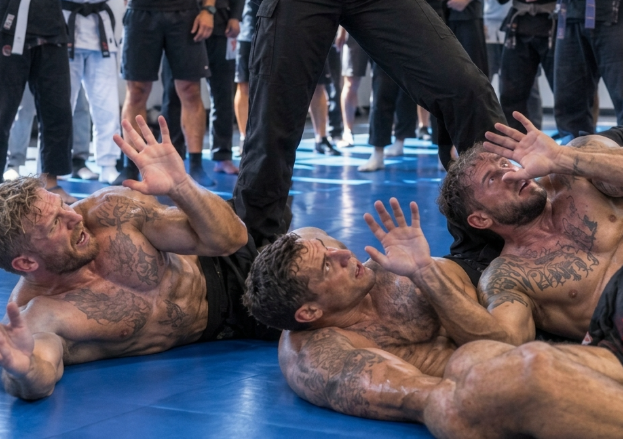
He grabbed my wrist and dragged me onto the main mat in front of two hundred people to prove I was a fraud !!
PART 2
Chase’s hand clamped around my right wrist like a vise. His fingers dug into my skin, right at the edge of my burn scars.
He yanked me forcefully forward. He expected me to stumble, to lose my balance, and to fall into the center of the blue mat.
He wanted the two hundred people watching to see me humiliated. He wanted his three tripod cameras to capture my panic.
But I didn’t panic. My resting heart rate stayed exactly where it always did when things went wrong.
I had crouched inside a burning armored vehicle in Kandahar province while enemy rounds cracked the air overhead. I knew the difference between a real threat and a fragile ego.
Chase was just a bully performing for an audience. And he had just made the biggest mistake of his life.
Instead of pulling away, I stepped into his pull. I dropped my center of gravity, planting my feet securely on the firm foam mat.
My left foot hooked smoothly behind his lead ankle. It was an outside sweep so old it probably predated the founding of this gym.
I rotated my hips exactly three inches. I used his own aggressive grip on my wrist as the perfect lever.
Physics took over. Chase’s feet left the mat completely.
He flew backward, his expression shifting from arrogant certainty to sudden, wide-eyed confusion. He hit the mat flat on his back.
His head bounced once off the high-density foam. The heavy, sickening thud carried all the way up to the rafters.
A woman in the second row gasped loudly. The entire building went dead silent.
Exactly three seconds had passed since he grabbed me.
Chase lay there, staring up at the ceiling lights, his chest heaving as the wind was knocked out of him. He didn’t understand what had just happened.
Before he could even roll over, Kellen lunged at me. The twenty-seven-year-old brown belt charged with a clumsy, wide overhand right.
Kellen still had his smartphone in his left hand, the live stream running to over thirty thousand viewers.
I didn’t step back. I slipped under his swinging arm the way you step out of a sudden rain shower.
In two quick, unhurried strides, I was completely behind him. My right arm threaded cleanly beneath his chin.
I locked in a textbook rear-naked choke. I didn’t squeeze to crush his airway; I just applied precise, inescapable pressure to his carotid arteries.
Kellen panicked. He dropped his phone.
It clattered onto the mat, the camera lens pointing straight up at the ceiling, still broadcasting live.
Six seconds later, Kellen was frantically slapping the mat with both hands. His face had turned a deep, desperate shade of red.
I released the choke instantly. Eleven seconds had passed.
Kellen collapsed onto his hands and knees, gasping for air, clutching his throat. He was completely out of the fight.
Weston didn’t learn from watching his friends fall. The wealthy white belt came in hot, swinging a wild, uncoordinated kick aimed directly at my head.
It was slow and broadcasted entirely by his shoulders. I tracked the movement easily.
I caught his leg midair. It was as simple as catching a grocery bag someone tossed to you from across a kitchen.
I stepped back, twisted my hips, and dropped my weight. I took Weston straight down into a perfectly controlled leg lock.
I secured the joint, applying just enough tension to let him feel the absolute boundary of his knee. I didn’t snap it. I just waited.
Weston screamed in terror. He immediately slapped the mat four times in rapid succession, a frantic, desperate rhythm.
I released his leg the second he tapped. Twenty-three seconds had passed.
Nobody in the building was sitting down anymore. Every person in the gallery was on their feet, their eyes wide, their phones recording.
I stood up and smoothed out my black polo shirt. I assumed it was over.
It wasn’t. Chase had scrambled back to his feet.
His face was the color of a stop sign. His fresh black gi was twisted messily around his ribs.
He was humiliated, bleeding ego, and he came at me with a wild, desperate overhand swing. He was carrying every ounce of rage he had left.
I didn’t block it. I slipped cleanly inside the arc of his heavy fist.
I caught his wrist with both hands, using his forward momentum against him again. I rotated my hips sharply.
I threw him over my hip, dropping him onto his back for the second time. I seamlessly transitioned into an armbar.
I locked my legs around his shoulder and pulled his arm straight. I stopped the pressure exactly at the millimeter edge of what his shoulder joint could physically survive.
“I tap!” Chase screamed in agony. “I tap! I tap!”
His voice echoed loudly enough that the cameras on the upper deck picked it up clearly from forty feet away.
I let go immediately. I stood up and took two steps back.
Exactly fifty-one seconds had passed. From the moment his hand closed on my wrist to the moment I released his arm.
Three men lay scattered on the mat. Kellen was retching quietly near his phone.
Weston was curled into a fetal position around his knee. Chase was sobbing softly into his own sleeve, his chest heaving with shame.
I didn’t gloat. I didn’t say a word to any of them.
I looked up into the crowded gallery. I found Colette standing in the third row, her hands covering her mouth in shock.
I found Paulette standing right beside her, her posture rigidly straight, a tight, proud smile on her face.
Then I found Skyler. The nineteen-year-old was leaning against the safety rail, her injured arm still strapped in its sling.
I met Skyler’s eyes and gave her one small, deliberate nod. I silently reminded her of the promise I’d written on the whiteboard.
You are not alone.
I turned my back on the three men on the floor. I walked calmly over to the equipment pile, picked up my canvas bag of training cones, and headed toward the side mat.
I had a three o’clock class to set up. I went to work like absolutely nothing had happened.
By six o’clock that evening, the clip of those fifty-one seconds had hit eleven million views.
By midnight, the Vanguard Fight Co. open house was trending across the entire country. The internet was exploding, but nobody knew my name yet.
Miles away, in a Legion Hall outside Medicine Hat, a retired master warrant officer named Desmond Octerburg was sitting at a corner table.
Desmond watched the viral footage on his phone. He set the device face down on the sticky wooden table and started laughing.
It was a slow, deep laugh that came all the way from his chest.
“I’d know that hip rotation anywhere,” Desmond muttered to nobody in particular. “Well, I’ll be damned. She’s back.”
Back in Calgary, in an upstairs office at Vanguard, Chase Ridgeway was not laughing.
He sat behind his desk with an ice pack pressed tightly to his shoulder. He was already on the phone with a high-priced lawyer.
He was deciding, right then and there, that he was going to utterly destroy my life.
He had no idea how badly that decision was about to fold in on itself.
By Sunday morning, the online narrative had aggressively flipped. Chase’s lawyer had moved fast.
They filed a massive civil suit and three criminal complaints against me. The charges were assault, uttering threats, and reckless endangerment.
Their official statement described me as an unstable employee with a documented history of violent outbursts.
They backed it up with sworn affidavits from Chase, Kellen, and Weston. All three men falsely claimed I had attacked them completely unprovoked.
Kellen took it a step further. He uploaded a newly re-edited version of his live stream.
The new video was only twenty-two seconds long. It completely cut out the beginning where Chase grabbed my wrist and dragged me.
It opened mid-motion on my hip rotation and ended right on Chase screaming, “I tap!” It made me look like an unhinged predator.
Kellen’s caption read: “Vanguard instructor assaults three coaches, charges pending.” It hit fourteen million views in six hours.
By noon on Sunday, Weston had posted a GoFundMe campaign. He attached a grim-looking MRI image of a severely torn knee ligament.
He claimed my leg lock required him to undergo emergency reconstructive surgery. The campaign crossed sixty thousand dollars by dinner.
By Sunday evening, the internet had firmly decided I was the villain. The hashtag JusticeForChase trended from coast to coast.

A national morning show host played Kellen’s edited clip on air. She shook her head sadly and used the phrase “clearly unwell.”
My phone didn’t stop vibrating all weekend. I didn’t answer a single unknown number.
Roy Callahan called me at 8:14 on Monday morning. His voice sounded heavy, tired, and deeply defeated.
“I have to suspend you pending the police investigation,” Roy said softly. “I’m sorry, Desiree. I really tried to fight this.”
“I understand, Roy,” I said, my raspy voice perfectly calm. “It’s the only logical business decision.”
“Your women are still on the books for tonight,” he added, sounding miserable. “I’ll cancel the class.”
“No,” I told him firmly. “I’ll call them myself.”
I sat alone at my small kitchen table after hanging up. A stack of unopened Veterans Affairs paperwork sat near my coffee mug.
I dialed Colette first. Then Paulette. Then I called the other six women, one at a time.
I told each of them the class was temporarily paused, not canceled. I promised them I wasn’t going anywhere.
One woman, a survivor of a brutal home invasion out in Cochrane, asked if I was safe in my own apartment.
“Yes,” I told her. It was the only lie I told all week.
By Monday afternoon, the Crown prosecutor had officially filed the three criminal charges. If convicted on all of them, I was facing up to eighteen months in prison.
The internet harassment spilled into the real world. Anonymous accounts started inventing wild, fabricated stories about my military past.
One highly shared post claimed I’d been dishonorably discharged for viciously assaulting a superior officer. It reached four million people before anyone even bothered to fact-check it.
The fallout hit my students, too. Colette’s coworkers at the grocery store saw the edited video.
They gathered around her register, asking if she was terrified of the crazy woman from her gym. Colette left her shift early and didn’t go back the next day.
Skyler’s parents called her at her university dorm. They had seen Kellen’s clip and frantically demanded to know if she was safe around me.
Skyler hung up on them, sobbing uncontrollably into her pillow.
A local reporter tracked down my address. He left three business cards shoved under my apartment door over two days.
I never opened the door. I just watched the shadows of his shoes from under the frame.
Paulette called me late Tuesday night. The former Navy corporal didn’t waste time on pleasantries.
“They’re eating you alive out there, Desiree,” Paulette said, her voice tight with anger.
“I know,” I replied quietly.
“What’s the plan?” she demanded.
“Renee is working it. I stay completely off social media. I trust the cameras.”
There was a long pause on the line. I could hear Paulette breathing steadily.
“Are you scared?” she finally asked.
I thought about the burning armored vehicle outside Kandahar. I thought about the smell of melting metal and the sound of my section mates screaming.
“I’ve been scared before, Paulette,” I told her. “This isn’t that.”
I sat in the dark for an hour after I hung up the phone. The city lights flickered through my single window, casting long shadows across the floor.
Then I stood up and pushed my bed aside. I dragged the heavy steel footlocker out into the center of the room.
I unlatched the heavy metal clasps. They snapped open with a sharp, echoing crack.
I lifted the lid. The smell of old canvas and brass polish drifted up into the quiet room.
Inside lay a small Canadian flag, neatly folded into a tight, crisp triangle. Beside it was the velvet presentation case.
Next to the case was a thick, sealed envelope from the Department of National Defence containing my complete, unredacted service record.
I took the velvet case out and opened it. The Star of Military Valour gleamed softly in the dim light.
I laid the medal, the flag, and the sealed envelope side by side on my kitchen table.
I took a clear, high-resolution photograph of all three items with my phone.
I attached the image to a text message and sent it to Renee Castellane. I typed exactly two words beneath the picture.
Full release.
Renee’s reply came back in less than ninety seconds. It was equally brief.
Confirmed. Filing tomorrow. They have no idea what’s coming.
Renee worked nineteen-hour days that entire week. My lawyer was a force of nature when she had a target locked.
She filed an emergency injunction for the original, uncut live-stream metadata from Kellen’s social media account. She wanted the exact timestamps.
She subpoenaed Vanguard Fight Co.’s internal security footage from every camera covering the main floor for the previous ninety days.
She requested Chase Ridgeway’s complete social media archive, digging back five full years. She wanted every deleted post and comment.
She subpoenaed Weston’s comprehensive medical records from the provincial health authority.
Finally, she filed an expedited Access to Information request with National Defence for my complete, unredacted service history. She also ran a background check on Chase.
Renee even managed to subpoena Kellen’s deleted drafts folder from his cloud storage. And a judge granted it.
By Wednesday evening, Renee had everything she needed. The trap was fully armed.
She found the original, unedited video feed. It clearly showed Chase aggressively grabbing my wrist and pulling me forward at exactly second fourteen.
She secured three different angles of the gym’s security footage. It proved I had displayed calm, non-threatening body language for forty-six minutes before the altercation.
She dug through Chase’s archived social media and hit a goldmine. She found six separate, distinct posts where he claimed to be a two-tour combat veteran.
He had used stolen, generic photographs pulled from stock military websites to build his entire public persona.
She got Weston’s medical file. The MRI he had used for his GoFundMe campaign contained embedded metadata proving it was taken two years before the open house.
The killing blow came from Kellen’s deleted cloud folder. Renee recovered a panicked text message sent from Kellen to Weston at 11:47 PM on the night of the fight.
“Bro,” the text read. “We got to sell the knee thing or we’re cooked.”
Renee printed every single document in triplicate. She color-coded everything meticulously into thick, heavy binders.
Then she called me. I could hear the absolute confidence in her voice.
“They built their entire case on three lies, Desiree,” Renee said smoothly. “And every single one of them is going to break on the same morning.”
“When?” I asked.
“Pre-trial evidentiary hearing. Thursday, nine a.m. sharp.” Renee paused. “Bring the medal.”
I was quiet for a moment, thinking back to the open house and the weeks before it.
“There was a man at the open house,” I said slowly. “Older, gray hair. He was standing at the back with Chase’s sponsors a few weeks ago.”
“I remember,” Renee said.
“He looked at me like he knew something. Like he recognized me.”
“I’ll find him,” Renee promised.
Thursday morning arrived crisp and cold. At 8:47 AM, I walked through the heavy glass doors of the Calgary courthouse on 5th Street.
I wore a plain, inexpensive charcoal suit I had bought off the rack two days earlier. I wore no jewelry, no makeup, and no flag pin.
I didn’t wear the medal. I just carried a simple steel watch on my wrist and a thick manila envelope tucked under my arm.
Chase, Kellen, and Weston were already sitting at the plaintiff’s table. They wore custom-tailored suits that cost more than my monthly rent.
Chase was smiling confidently, whispering something to his expensive lawyer. Weston sat beside him, wearing a bulky, completely unnecessary hinged knee brace over his trousers.
The courtroom gallery was packed to capacity. Reporters with notepads, gym sponsors, and curious onlookers filled the wooden benches.
But six rows were taken up entirely by my people.
Colette was there. Paulette sat beside her, her posture rigidly military. The rest of my night class filled the row behind them.
Skyler sat near the aisle, her arm still strapped securely in its sling, looking nervous but determined.
Two soldiers I had served with in Kandahar had flown in. They sat quietly in the back row, wearing dark suits.
And sitting right next to them was the older man with the gray hair. He wore a tiny, barely visible Canadian Armed Forces lapel pin on his collar.
Judge Corretta Vance, a stern woman with sharp eyes, called the busy room to order. The dull roar of conversation died instantly.
Renee stood up slowly. She buttoned her suit jacket and stepped confidently toward the center of the floor.
“Your Honor,” Renee began, her voice clear and authoritative. “The plaintiff’s entire case rests heavily on three foundational claims.”
Judge Vance looked over her reading glasses. “Go on, Counsel.”
“They claim that my client attacked them entirely without provocation,” Renee said, ticking the points off on her fingers. “They claim that Mr. Blackwood sustained a severe knee injury in this specific incident.”
Chase’s lawyer scoffed quietly. Renee ignored him.
“And finally,” Renee continued, “they claim that my client has a documented, unstable history of sudden violence.”
Renee turned and looked directly at Chase. “Each of these three claims is demonstrably false. And I intend to prove all three this morning.”
Renee walked to her table and picked up a tablet. She connected it to the courtroom monitor.
“Exhibit A,” Renee announced. “The uncut, original live-stream video, with all original digital timestamps intact.”
The large screen flickered to life. At exactly second fourteen, the entire courtroom watched Chase’s hand close aggressively around my wrist.
They watched him violently yank me forward onto the mat. The unprovoked aggression was undeniable.
Chase’s lawyer leaned in quickly to whisper frantically in his client’s ear. Chase’s confident smile faded down a noticeable notch.
“Exhibit B,” Renee said without missing a beat, handing a printed sheet to the bailiff. “A recovered text thread between Mr. Pruitt and Mr. Blackwood.”
The bailiff handed the sheet to Judge Vance.
“Sent the night of the incident,” Renee read aloud. “‘Bro, we got to sell the knee thing or we’re cooked.'”
Weston’s face immediately went the color of old, damp paper. Kellen slumped forward and stared fixedly at the floor tiles.
“Exhibit C,” Renee continued mercilessly. “The medical metadata for Mr. Blackwood’s MRI file.”
She held up a bright blue folder.
“This scan was taken two full years prior to the open house incident. It is a pre-existing sports injury being used to solicit fraudulent public donations.”
A reporter sitting in the second row whispered, “Oh my god,” loud enough to carry across the quiet room.
Weston’s lawyer jumped up quickly. “Your Honor, I request a brief recess to confer with my client.”
“Denied,” Judge Vance snapped coldly. “Proceed, Counsel.”
“Exhibit D,” Renee said softly. She turned slowly to face the plaintiff’s table directly.
“Mr. Ridgeway has spent the last five years aggressively marketing himself as a two-tour combat veteran of the Canadian Armed Forces.”
Chase swallowed hard. His hands started to tremble slightly on the polished wood of the table.
“He has appeared on four prominent podcasts, two televised local interviews, and used this claim in thirty-one highly visible sponsored posts,” Renee detailed.
She raised a thick yellow folder.
“Through this fabricated identity, he has accepted veteran-affiliated corporate sponsorships totaling over two hundred and ninety thousand dollars.”
The courtroom was dead silent. Even the reporters stopped typing.
“This,” Renee said, her voice dropping to a hard whisper, “is the official response from National Defence to Access to Information Request 2026A114.”
She handed the sealed document to the bailiff.
“It confirms, definitively, that there is absolutely no record of any individual named Chase Michael Ridgeway, matching this date of birth, ever having enlisted, served, or been discharged from the Canadian Armed Forces in any capacity.”
Renee lowered the empty folder to her side.
“Your Honor, Mr. Ridgeway has committed stolen valor under multiple provincial consumer protection statutes. He is also exposed to severe federal wire fraud charges regarding his sponsorships.”
She looked straight at Chase’s pale, terrified face.
“My office will be referring all of this evidence directly to the Calgary Police Service Economic Crimes Unit at the close of this hearing.”
Chase’s face went bone white. He looked like he was going to be physically sick right there at the table.
The courtroom didn’t make a sound. The air felt thick and electric.
But Renee wasn’t finished. She walked back to her table and took a sip of water.
“I’d like to call my first witness to the stand,” Renee said clearly. “Mr. Isaac Thorne, assistant instructor at Vanguard Fight Co.”
Isaac walked slowly from the back of the gallery up to the wooden witness stand. He was thirty-eight, sandy-haired, and usually kept to himself.
He had been Chase’s quiet second-in-command for four years. But it turned out Isaac had been keeping very careful notes.
The clerk swore him in. Renee approached the stand gently.
“Mr. Thorne,” Renee asked. “How many times in the past month did you personally hear Mr. Ridgeway describe my client as ‘too soft for real combat’?”
Isaac adjusted his collar nervously. “At least six times. Probably more.”
“How would you characterize his overall conduct toward Ms. Colwin during her employment?”
Isaac took a long, shaky breath. He looked briefly at Chase, then turned back to Renee.
“It was harassment,” Isaac said firmly. “It was racialized. It was constant, daily bullying.”
“Did anyone try to stop him?”
“No,” Isaac admitted softly. “Every single one of us was too scared to say anything. Chase controlled the schedule, the paychecks, and the sponsors.”
Isaac gripped the edge of the wooden railing. He looked directly at Chase, his voice hardening.
“But I’m done being scared of him,” Isaac stated clearly.
Renee thanked him and let him step down. She turned back to the gallery.
“I call my second witness,” Renee announced.
The older, gray-haired man sitting in the back row stood up tall. He walked down the center aisle with the distinct, measured stride of a career soldier.
He took the stand and swore the oath smoothly.
“Please state your name and record of service for the court,” Renee requested.
“Master Warrant Officer Desmond Octerburg, Canadian Armed Forces, retired,” the man said. His voice was deep, commanding, and easily filled the room. “Twenty-six years of active service.”
“What was your role between 2011 and 2015?”
“I ran the advanced close-quarters combatives training facility out of CFB Suffield,” Desmond answered precisely.
He paused and looked out into the gallery, finding me in the crowd. He offered a tiny nod.
“Desiree Colwin was my colleague there,” Desmond told the quiet room.
“Can you describe her qualifications?” Renee asked.
“She trained the trainers,” Desmond stated flatly. “She held the absolute highest close-combat instructor certification that the Armed Forces can possibly award.”
He leaned forward slightly, resting his hands on his knees.
“And she is, without any exaggeration, one of the three most dangerous hand-to-hand operators I have ever had the privilege of standing beside in uniform.”
A reporter in the back row stood up abruptly to get a better look at me. Another one followed.
“On the fourth of March, 2020,” Desmond continued, his voice dropping slightly into a solemn register. “Outside Kandahar, her armored convoy struck a massive roadside device.”
The courtroom was so quiet I could hear the hum of the air conditioning vents.
“The lead vehicle immediately caught fire,” Desmond said grimly. “Two soldiers were killed instantly. Three more were trapped inside the burning hull.”
He looked directly at Judge Vance.
“Master Corporal Colwin suffered a severe, partial laceration to her vocal cords from flying shrapnel. She also sustained deep second-degree burns to her right forearm.”
Desmond pointed a thick finger toward me.
“With her own uniform sleeve physically on fire, she went back into that vehicle three separate times. She pulled all three trapped men out.”
Desmond gestured toward the fourth row of the gallery.
“Two of those men are alive today because of her.”
A man in his early thirties stood up from the wooden bench. The metallic glint of a prosthetic leg was clearly visible beneath his tailored suit trousers.
He raised his hand silently. The other surviving soldier stood up beside him.
“For those actions,” Desmond said softly, “she was awarded the Star of Military Valour by the Governor General of Canada.”
Desmond reached inside his jacket pocket.
“I have a certified, official copy of the citation here.”
He handed the thick paper to the bailiff, who promptly passed it up to Judge Vance. The judge adjusted her glasses and read it aloud.
“For conspicuous gallantry and total disregard for her own personal safety in the successful rescue of fellow soldiers under heavy enemy fire, Master Corporal Desiree Colwin, Canadian Armed Forces.”
The room did not make a single sound. The silence was absolute, heavy, and profound.
Chase Ridgeway had buried his face in his hands. He was crying silently, his shoulders shaking.
Weston was staring blankly at the tips of his expensive leather shoes. Kellen hadn’t lifted his head from the table in four minutes.
“Your Honor,” Renee said gently, breaking the silence. “With the court’s permission, my client would like to make a brief statement.”
Judge Vance nodded slowly. “Granted.”
I stood up from the defense table. I walked up to the wooden witness stand without carrying any notes. I hadn’t brought the medal.
I stood there for a moment, letting the silence settle. I looked at Chase for one long, unforgiving second.
Then I looked at Skyler, who was wiping a tear from her cheek. Finally, I looked up at the judge.
My damaged vocal cords grabbed at the air, making my voice rough, raspy, but perfectly clear.
“I chose restraint,” I said. Three simple words.
Judge Vance closed the thick legal file sitting on her desk with a definitive snap.
“All charges against Ms. Colwin are dismissed with absolute prejudice,” the judge declared loudly.
She looked down at the plaintiff’s table with undisguised contempt.
“Mr. Ridgeway, Mr. Voss, Mr. Pruitt, and Mr. Blackwood. You will all be remanded immediately for an evidentiary review.”
Judge Vance banged her gavel sharply.
“The very serious matters of fraudulent misrepresentation, filing false police reports, and criminal conspiracy will be formally referred to the appropriate authorities effective immediately. We are adjourned.”
The gavel came down a second time. It sounded like a gunshot.
I walked slowly out of the witness box. I walked right past three broken men in expensive suits, sitting silently at a table that had become the absolute wreckage of their own arrogant making.
The social media hashtags violently flipped again before sundown.
JusticeForDesiree dominated the trending charts. ChooseRestraint became a rallying cry.
Within seventy-two hours, the Calgary police formally charged Chase Ridgeway with multiple counts of consumer fraud, perjury, and criminal conspiracy.
Every single corporate sponsorship he held was officially terminated within the week.
The national martial arts federation that had originally certified him revoked his credentials publicly and permanently.
Chase eventually pleaded guilty in a plea deal to avoid jail time. He received eighteen months of strictly supervised probation and mandatory financial restitution.
He was also handed a lifetime ban from holding any coaching or instruction certification anywhere in Canada.
Kellen desperately cooperated with the Crown prosecutor in exchange for a significantly reduced sentence.
He received twelve months of probation and four hundred hours of mandatory community service. The judge ordered him to teach self-defense to at-risk youth in the inner city.
It was a placement chosen specifically so he’d have to face, every single week, the exact kind of vulnerable young people whose pain he had once casually turned into viral internet content.
Weston’s wealthy family panicked. They quietly settled a massive civil defamation suit with Renee for an undisclosed, highly lucrative sum.
The only condition was to keep his name completely out of any further legal proceedings.
The massive settlement check cleared on a Tuesday morning. Weston immediately moved out to a secluded property in the Okanagan Valley and was never seen or heard from at a Calgary gym again.
Roy Callahan looked like he had aged ten years. He held a somber press conference on the front steps of Vanguard Fight Co. on a cold, wet Friday afternoon.
He didn’t hold any prepared notes in his hands. He just looked at the cameras with tired, defeated eyes.
“I built this gym over eleven hard years,” Roy told the reporters. “But I let it become something I am deeply, profoundly ashamed of.”
Roy swallowed hard.
“I failed Desiree Colwin. I failed Skyler Nunn. And I failed every single woman who walked through these glass doors looking for something safe, only to find cruelty and arrogance instead.”
Roy looked down at the concrete steps.
“I’m selling the gym immediately,” he announced. “I’m leaving the fitness industry entirely. And I am publicly asking Desiree Colwin to accept an apology that no words of mine will ever be big enough to properly cover.”
Roy was true to his word. He sold the entire facility three weeks later.
He sold it to me. For exactly one dollar.
I had the old Vanguard banners ripped down the next morning. I renamed the facility.
The new sign over the front door read just two words in plain, stark white lettering against a matte black background: Quiet Hours.
I used the massive financial settlement money from Weston’s family to fundamentally change how the business operated.
I made every single class entirely free for women veterans, survivors of domestic violence, and absolutely anyone with a referral from a women’s shelter or a VA caseworker.
The old night class quickly became the busy day class. The day class rapidly expanded to run seven days a week to handle the overwhelming demand.
Skyler Nunn was the first person I hired.
Her shoulder fully healed within six months. She became my first official assistant instructor.
Skyler taught beginner jujitsu on Saturday mornings to a packed class of fourteen nervous women. Most of them cried at least once during their first month on the mats, but every single one of them kept coming back.
Colette found her voice. She started teaching an “Intro to Fear Management” course every Wednesday evening.
Paulette took over the heavy conditioning. She ran a brutal, military-style ground recovery and strength class on Tuesdays.
The women from my original eight-person night class naturally became the core leadership team of the new facility.
The phrase “Choose Restraint” crossed two million tagged posts online within four months.
Women in nineteen different countries started their own grassroots self-defense circles. They used the comprehensive training curriculum I had quietly posted online for free, with absolutely no copyright restrictions attached.
Six months after the courtroom verdict, the Alberta provincial legislature formally introduced a new private member’s bill.
The legislation legally required every certified martial arts instructor in the province to undergo rigorous annual background checks and mandated the strict reporting of all student injuries.
The bill passed overwhelmingly with broad support from both sides of the house.
The provincial minister signed the document at a press conference standing right inside the front doors of Quiet Hours.
I stood exactly two feet behind him, wearing my black polo shirt, saying absolutely nothing at all. I didn’t need to speak. The work was speaking for me.
A year later, the gym still opens at six o’clock every morning.
The bright fluorescent lights hum softly as they come up over the wide, blue training mats. The foam is worn soft and comfortable in all the right places.
There are no giant, arrogant posters of anyone’s face plastered on the mirrored walls.
There is just one small, quiet framed photograph hanging above the reception desk.
It shows three young soldiers covered in soot, thick black smoke billowing behind them. Every single person in the picture is still alive.
On a cold Tuesday morning, I am teaching a beginner fundamentals class to twelve new women.
Half of them are recent military veterans trying to find their footing. Three are recent survivors of severe domestic violence.
One is a sharp-eyed Crown Prosecutor who squeezes in ground recovery training on her lunch hour.
My voice is significantly stronger now than it was a year ago.
The jagged scar tissue on my vocal cords hasn’t gone anywhere. It never will. The rasp is permanent.
But I’ve built the muscle around it, pushing air through the damage breath by breath, class by class.
I’ve learned how to force the words out so they form roughly the shape and volume I mean them to.
After the intense morning class ends, the women slowly file into the locker rooms. A young woman stays behind on the mat to help me fold the heavy crash pads.
Her name is Farah Whitcomb. She is twenty-three years old, and she is only three weeks out from a difficult medical release from the armed forces.
Farah has been coming to Quiet Hours every morning since her second week in the city. She hasn’t told anyone in the class why she left the military. I haven’t asked.
As we lift a heavy blue mat together, Farah stops. She looks closely at the thick, jagged scarring running along my right forearm.
She finally asks the question she’s been carrying silently for twenty-one straight days.
“Coach,” Farah asks softly, her eyes tracing the burn lines. “Where did you get the scar?”
I don’t flinch. I don’t pull my arm away or pull my sleeve down.
I raise my right hand slowly. I sign a small, sharp, specific shape in the air with my fingers.
It is the sign language word for fire.
It was the very first word I had painstakingly taught myself in the dark, silent months after Kandahar, back when speaking aloud still cost me far too much physical pain.
Then I lower my hand to my side. I look Farah directly in the eyes, and I use my actual voice instead.
It comes out rough, clear, and perfectly steady.
“Fire,” I tell her simply. “And family.”
Farah stares at me for a long moment. Then she nods slowly, understanding exactly what I mean without needing any further explanation.
She doesn’t say anything else. She just sits down quietly beside me on the edge of the blue mat.
We sit there for a few minutes, listening to the hum of the building. Then we stand up and fold the rest of the heavy crash pads together in total, comfortable silence.
Deep inside a small wooden cabinet in the back office, exactly two objects sit side by side on a dusty shelf.
One is the gleaming Star of Military Valour, no longer hidden face down in a dark metal box.
The other is a small, black clip-on body camera. It is permanently retired now, its glass lens covered securely with a thick strip of black electrical tape.
They are two very different tools. One was built for survival, the other was built for proof. Both of them are still, in their own quiet way, entirely in service.
I stood in the quiet office for a long time, looking at the medal and the camera resting on the shelf.
The silence in my apartment used to feel like a holding cell, a heavy weight pressing down on my chest. Now, the silence in this gym felt like a sanctuary.
I walked back out onto the main floor. The morning sun was just starting to crest over the Calgary skyline, casting long, warm beams of light through the wide front windows.
The blue training mats seemed to glow in the quiet light, worn soft by the thousands of hours of hard work, tears, and recovery that had taken place on them.
This space didn’t belong to a fragile ego anymore. It didn’t belong to men who needed to stand on someone smaller just to feel tall.
It belonged to Colette, and Paulette, and Skyler. It belonged to Farah, and to every woman who had ever been told she was too soft for a fight she was actually built to win.
I ran my hand along the edge of the front reception desk, feeling the solid, grounding wood beneath my scarred knuckles.
I had lost my voice in the burning wreckage outside Kandahar, but I had finally found a different way to speak. I had built a place where restraint was a choice, not a mandate born of fear.
I turned off the main overhead fluorescent lights, leaving only the soft, golden glow of the morning sun filling the room.
I locked the heavy front door of Quiet Hours and stepped out into the crisp, cold Alberta air.
It was time to go home.