My Son Thought the Mansion Was His. By Sunrise, He Learned I Had Left Him Something Far Worse Than Nothing !!
The first time my son struck me, the room went so silent I could hear the chandelier crystals trembling above us.
Not the guests.
Not his wife.
Not even Julian himself.
Only the chandelier, glittering over the long marble dining room like a thousand frozen tears, seemed to understand that something sacred had just broken.
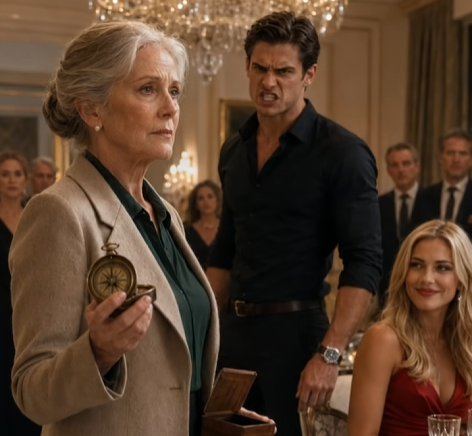
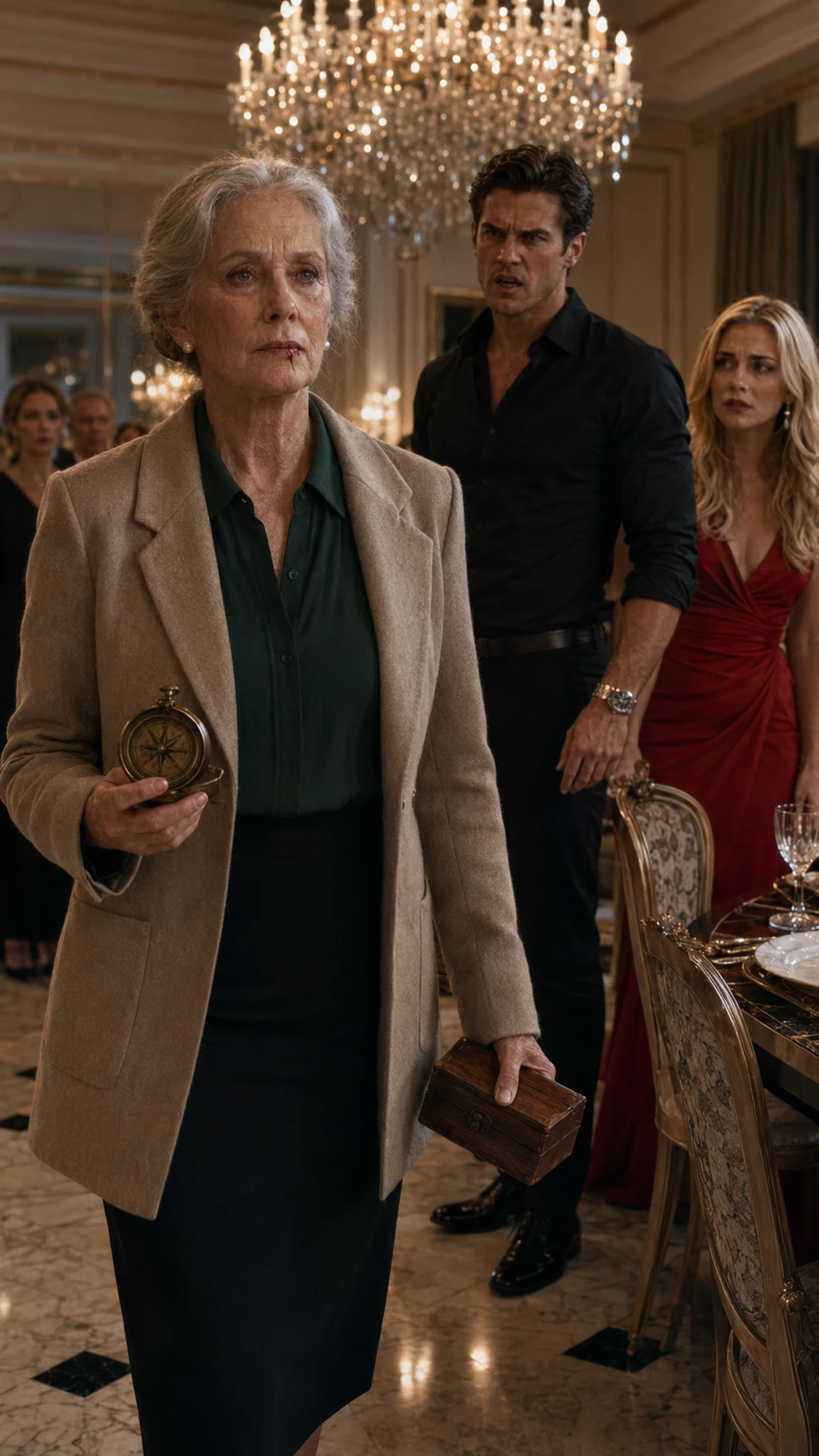
I stood in the center of his Beverly Hills mansion with a small wooden box in my hands, wearing the same beige coat he had once said made me look “like someone’s old housekeeper.” My lip stung. My cheek burned. But the pain was nothing compared to the cold, clean emptiness spreading through my chest.
Julian Vance—my only son, my miracle, the boy I had raised alone after burying his father—stood before me in a black designer shirt, breathing hard, his handsome face twisted with disgust.
Behind him, his wife Chloe smiled.
That smile was the thing I remembered most.
Not the blow. Not the gasps. Not the way the guests stared down at their champagne glasses, pretending they had not just watched a son humiliate his mother.
**It was Chloe’s smile—small, polished, satisfied—as if she had been waiting years for this moment.**
“Get out,” Julian said, his voice low and shaking with fury. “You useless relic.”
A few people flinched.
No one spoke.
I looked down at the open wooden box in my hands. Inside, nestled against faded velvet, was an antique brass compass. Its lid was scratched. Its glass was cloudy with age. To anyone else, it was just an old object. To me, it was the last true piece of my husband, Daniel.
He had carried it when we were young and poor and foolish enough to believe love alone could build a life.
“Whenever I lose my way,” he used to say, pressing it into my palm, “this reminds me where home is.”
Daniel died before he could build the company he dreamed of. He left behind hospital bills, debt, and a five-year-old boy who cried into my apron every night asking when Daddy was coming back.
So I became both parents.
I worked construction sites in boots too big for me. I learned contracts from men who laughed when I entered the room. I lifted, negotiated, failed, started over, and fought my way through forty years in an industry that had no soft place for widows.
I built highways. Office towers. Shopping plazas. Luxury homes for people who would never know my name.
And then, one day, I built an empire.
But somehow, in giving Julian everything, I had raised a man who believed he had earned it all.
It was his thirtieth birthday dinner. The mansion sparkled with wealth—gold-rimmed plates, imported roses, candles flickering in crystal holders, expensive suits, women in silk and diamonds. The house sat on a hill with a sweeping view of Los Angeles, all glittering lights and fake promises.
Julian loved that view.
He loved telling people, “I bought this place young.”
I never corrected him.
Five years earlier, after closing the largest deal of my career, I purchased the property outright. I let Julian and Chloe move in after their wedding. I told them, “Think of it as your home.”
They heard, “It belongs to you.”
But that was never true.
**The mansion belonged to an LLC. And I was the sole owner.**
At first, I had no intention of ever taking it back. A mother wants to believe her child will grow into kindness if given enough safety. I thought comfort might soften Julian. Instead, it sharpened his cruelty.
He stopped calling me Mom in front of guests.
Chloe began sending messages like, *Please schedule visits at least two weeks in advance.*
At dinner parties, Julian would laugh and say, “My mother got lucky in real estate,” as if luck had poured concrete, signed permits, survived lawsuits, and kept men from stealing my company out from under me.
Still, I smiled.
Because a mother’s hope is often the last thing to die.
That night, I brought him the compass.
Not because it was expensive, but because it mattered. I thought maybe, beneath the watches and cars and arrogant friends, some part of the little boy who missed his father might still exist.
Julian opened the box, stared at the compass, and laughed.
“This is your gift?”
Chloe tilted her head, blonde hair spilling over her red satin dress. “How sweet. Old junk.”
I felt the room shift. Guests looked away, embarrassed not for me, but because humiliation is uncomfortable when it ruins dinner.
“It was your father’s,” I said.
Julian picked up the compass between two fingers, as if touching something dirty. “My father left nothing.”
“He left you a name,” I said quietly. “And he left you love.”
Julian’s mouth hardened. “Love didn’t buy this house.”
“No,” I said. “It didn’t.”
For the first time that evening, his eyes narrowed.
I looked around the room—the mansion, the guests, the wife who treated me like a stain on her silk life—and something inside me finally settled.
Then I said the words that lit the match.
“Be careful not to forget who built the ground you’re standing on.”
Julian stood so fast his chair scraped across the marble.
“You always do this,” he snapped. “You show up acting humble, but you want everyone to know what you did. You want gratitude. Worship. Applause.”
“I wanted respect,” I said.
His face twisted.
And then his hand came up.
The first strike stunned me more than it hurt. The second made someone gasp. By the third, Chloe had stopped pretending to be shocked.
I did not scream.
I did not beg.
**I counted.**
One.
Two.
Three.
Not aloud, not at first. Only in my mind.
Each one removed something.
The memory of Julian asleep on my chest as a baby.
The birthday cakes I made from boxed mix because money was tight.
The nights I stayed awake beside him during fevers.
The school shoes I bought while wearing my own with holes in the soles.
By the time he stopped, I was no longer looking at my son.
I was looking at a stranger wearing his face.
The room was frozen around us. A guest near the far window had a phone half-raised, then lowered it when Chloe glanced at him. Julian’s chest rose and fell. He looked almost frightened by what he had done, but pride quickly covered it.
“Leave,” he said.
I bent slowly, picked up the compass from where it had fallen, and closed my hand around it.
Then I looked at Chloe.
Her smile faltered.
Perhaps she saw it first—the absence of fear.
I turned and walked toward the door.
Behind me, Julian muttered, “That’s right. Walk away.”
I stopped at the threshold but did not turn around.
“I did everything I could to make you a man,” I said. “Tonight, you proved I only made you rich.”
No one breathed.
Then I left.
Outside, the February air bit into my face. My driver, Mr. Alvarez, rushed from the car when he saw me.
“Mrs. Vance—”
“I’m fine,” I said.
He looked at my lip and knew better than to argue.
In the back seat, I opened my phone and made three calls.
The first was to my attorney.
The second was to my business manager.
The third was to a woman named Evelyn Park, who had been trying to buy that mansion for six months.
But Evelyn was not a developer.
She was the director of the Daniel Vance Foundation for Displaced Families, a charity I had quietly funded for years.
The mansion, by sunrise, would no longer be Julian’s stage.
It would become a shelter for women and children escaping homes where cruelty wore expensive clothes.
My attorney hesitated only once.
“Margaret,” he said, “are you certain?”
I looked down at Daniel’s compass resting in my lap.
“Yes,” I said. “I finally know where home is not.”
By 6:15 the next morning, the transfer documents were signed. By 7:30, security codes were changed. By 8:00, Julian received notice that occupancy permission had been revoked.
At 8:04, my phone began ringing.
I watched his name flash across the screen.
Once.
Twice.
Six times.
I did not answer until the seventh.
“Mom?” Julian’s voice cracked. “What did you do?”
I sat at my kitchen table in my small old house—the one I had kept all these years because it was the last place Daniel had kissed me goodnight. Morning light spilled across the worn wood floors. The compass sat beside my tea.
“What I should have done long ago,” I said.
“You can’t sell my house.”
“It was never your house.”
Silence.
Then a brittle laugh. “That’s insane.”
“The deed is held by Vance Holdings Residential LLC. You were permitted to live there. Nothing more.”
Chloe’s voice shrieked in the background. “Julian, tell her to stop this!”
“Mom, listen,” he said quickly. “I was angry. I shouldn’t have—things got out of hand.”
“Yes,” I said. “They did.”
“Reverse it.”
“No.”
“You’re ruining me!”
I closed my eyes. For one trembling second, I heard the boy he used to be. The one who crawled into my bed after nightmares. The one who once gave me a dandelion and said, “For the prettiest mommy.”
But grief can be a liar. It tells you the past can excuse the present.
It cannot.
“You ruined yourself,” I said.
His breathing turned ragged. “Please. Chloe’s parents are coming next week. My investors—everyone thinks—”
“Everyone thinks you own what you never earned.”
That silenced him.
Then he said something I did not expect.
“Dad would hate you for this.”
My hand tightened around the phone.
For the first time since the dinner, anger rose hot and sharp.
“Your father,” I said slowly, “would not recognize the man who raised his hand to me.”
He said nothing.
I hung up.
By noon, the story had begun spreading. Not because I leaked it. One of the guests had recorded just enough before shame made him stop. The clip was short, but it was enough: Julian shouting, Chloe laughing, my face after the strike.
Investors pulled back. Friends vanished. Chloe’s social accounts went private. The luxury cars disappeared from the driveway one by one.
But that was not the twist.
The real twist came three days later, when my attorney called.
“Margaret,” he said, sounding unsettled, “you need to come in.”
At his office, he placed a thin envelope on the table. It was old, yellowed at the edges, and sealed with Daniel’s initials.
“We found this in the original trust archive,” he said. “It was attached to the old family documents from before your company restructured. Daniel wrote it before he died.”
My fingers trembled as I opened it.
Inside was a letter addressed to me.
*My Maggie,* it began.
I had not seen his handwriting in forty years.
The letter was short. Daniel wrote that if he did not survive his illness, he wanted me to protect our son—but never at the cost of losing myself. Then came the line that made the room tilt.
*If our boy grows into a man who forgets kindness, give my compass to someone who still needs a way home.*
Beneath the letter was a second page.
A legal note.
Daniel had left instructions that the compass was never meant to be inherited by Julian automatically. It was to be passed only if Julian became “a man of humility, courage, and compassion.”
If not, it was to go to a child in need.
I began to cry—not loudly, not dramatically, but with a quiet grief that felt forty years late.
Daniel had known.
Somehow, before Julian even had a chance to become cruel, Daniel had understood the danger of raising a child with too much pain and too much privilege.
That evening, I visited the mansion for the last time before the foundation opened its doors.
The dining table was gone. The chandeliers remained, but beneath them were rows of clean beds, children’s books, folded blankets, and donated clothes. The marble halls no longer echoed with arrogance. They carried something softer.
Hope.
Near the entrance stood a little boy, maybe six years old, clutching his mother’s coat. His eyes were wide and frightened, the way Julian’s had been after Daniel died.
I knelt carefully in front of him.
“What’s your name?” I asked.
“Leo,” he whispered.
His mother apologized for him, but I shook my head.
From my pocket, I took Daniel’s compass.
The boy stared at it.
“This belonged to someone very brave,” I said. “He believed it could help lost people find their way.”
Leo touched it gently. “Does it work?”
I looked around the mansion—at the beds, the mothers, the children, the place my son had used as a crown and I had turned into a refuge.
Then I smiled through my tears.
“Yes,” I said. “It finally does.”
A week later, Julian came to see me.
He looked thinner. Unshaven. Smaller somehow, without the mansion behind him.
“I lost everything,” he said.
I studied him from my porch.
“No,” I answered. “You lost the things. You still have the chance to find yourself.”
His eyes filled.
For a moment, I thought he might apologize.
Truly apologize.
Instead, he looked past me into the house and whispered, “Did you really give Dad’s compass away?”
I nodded.
His face broke—not with guilt, but with disbelief that something he had rejected could no longer be reclaimed.
That was when I understood the final truth.
**Some people do not mourn what they destroyed. They mourn only when they realize they can never own it again.**
I closed the door gently.
And for the first time in my life, I did not feel like I had lost a son.
I felt like I had finally found Margaret Vance.