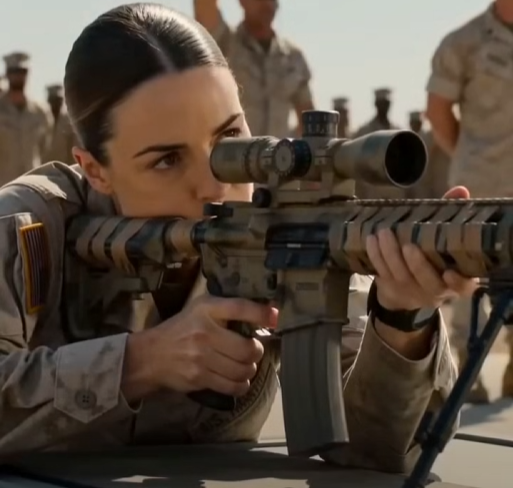
The Captain Everyone Mocked Was the Only Shooter Who Knew !!
By the time Captain Mara Ellison placed her battered rifle on the firing mat, two hundred soldiers had already decided she did not belong there.
By the time the final shot echoed across the Nevada desert, the man who humiliated her was waiting for her permission to speak.
Heat shimmered above the long-range course at Fort Rainer, a sprawling Army installation outside Las Vegas.
The July sun pressed against the concrete firing line with punishing weight.
Dust gathered on combat boots, spotting scopes, rifle cases, and the steel railings surrounding the crowded bleachers.
Soldiers filled every available seat.
Civilian contractors stood along the fences.
Senior officers watched from a shaded command platform near the range tower.
Staff Sergeant Nolan Briggs stood in Lane One with the relaxed confidence of a man expecting another victory.
He had won Fort Rainer’s long-range championship eight consecutive years.
His photograph hung inside the training center.
His name appeared in recruiting videos.
New shooters studied recordings of his matches before attending advanced qualification.
That morning, he had arrived with a polished rifle, a custom shooting jacket, and three cameras following him.
Captain Mara Ellison arrived alone.
She wore a standard field uniform with neatly fastened sleeves.
Her cap sat low over her eyes.
A plain black range bag hung from one shoulder.
Nothing about her entrance demanded attention.
Briggs made sure everyone noticed her anyway.
“You took a wrong turn, Captain,” he called across the firing line.
Several soldiers laughed.
Mara stopped beside Lane Two.
Briggs looked toward the bleachers and raised his voice.
“This is the sniper final,” he said. “Administrative processing is two buildings east.”
The laughter grew louder.
A few soldiers exchanged embarrassed glances, but nobody challenged him.
Briggs had influence on the range.
He trained many of the shooters seated in the stands.
He also had a reputation for remembering every public disagreement.
Mara lowered her range bag onto the concrete.
She did not defend herself.
She did not glare at Briggs.
She simply knelt and opened the zipper.
Her silence made the laughter fade faster than anger would have.
Briggs watched her remove a folded mat.
“You are serious,” he said.
Mara placed the mat inside her lane.
“That is usually why people enter a final.”
A few soldiers smiled.
Briggs heard them.
His grin tightened.
Near the microphone stand, civilian announcer Daniel Price checked his notes.
He had spent years covering military competitions and understood when a crowd was turning restless.
“Today’s finalists are Staff Sergeant Nolan Briggs and Captain Mara Ellison,” Daniel announced.
The title changed the atmosphere.
Several soldiers straightened.
Some had assumed Mara was a visiting staff officer.
Others believed she had wandered onto the range by mistake.
Briggs recovered quickly.
“Rank does not make the bullet fly straighter,” he said.
Mara looked at him.
“No,” she replied. “Training does.”
The answer was quiet.
It still reached the front rows.
Briggs stepped closer to Lane Two.
“Have you ever fired beyond eighteen hundred meters?”
“Yes.”
“Under competition conditions?”
“Yes.”
“At this range?”
Mara paused.
“Not under these conditions.”
Briggs turned toward the crowd.
“There it is.”
Laughter returned, though less confidently.
Mara removed her rifle from the bag.
The weapon looked old beside Briggs’s polished equipment.
Its stock carried scratches near the cheek rest.
The scope housing showed signs of repeated field use.
Faded tape wrapped around the rear section, marked with nearly illegible numbers.
Briggs stared at it.
“Did supply issue that during the first Gulf War?”
“No.”
“You buy it at a pawn shop?”
“No.”
He waited for more.
Mara checked the chamber and said nothing else.
Briggs crouched beside his rifle.
He glanced toward the command platform, making sure the senior officers were watching.
Colonel Elias Ward stood near the center rail.
Beside him, Command Sergeant Major Grant Rourke stared at Mara’s rifle with unusual concentration.
Ward noticed.
“You recognize her?” he asked.
Rourke kept watching the range.
“I recognize the weapon.”
“From where?”
Rourke did not answer immediately.
Below them, Mara attached the bipod and tested each leg.
Her movements were economical and precise.
She never looked down while adjusting the scope.
Rourke stepped closer to the railing.
Ward studied him.
“What are you not telling me?”
Rourke’s jaw shifted.
“I am trying to determine whether I should tell you here.”
Daniel raised the microphone again.
“The final target is positioned at two thousand one hundred thirty meters.”
A murmur moved through the bleachers.
The distance was extreme, even for experienced military marksmen.
Heat distortion twisted the view downrange.
Crosswinds moved unpredictably through the dry basin.
The circular steel plate looked smaller than a coin through the unaided eye.
Daniel continued.
“Each competitor receives one official shot.”
“Distance from center determines the winner.”
“In the event of equal deviation, the range judges will review impact timing and ballistic data.”
Briggs lowered himself behind his rifle.
He worked slowly enough for the cameras to capture every movement.
“Try not to embarrass the officer corps,” he told Mara.
She spread her mat flat.
“You have embarrassed enough people for both of us.”
The crowd went silent.
Briggs lifted his head.
For the first time, the insult had found him instead.
Mara settled behind her rifle.
The transformation was immediate.
Her shoulders relaxed.
Her breathing changed.
Her cheek found the stock without searching.
Her left hand rested in exactly the same position each time she adjusted.
Rourke gripped the command railing.
“That position,” he said.
Ward looked at him.
“What about it?”
“I have seen it before.”
“Where?”
Rourke’s eyes remained fixed on Mara.
“Afghanistan.”
Ward lowered his voice.
“With her?”
“No.”
Rourke finally looked at him.
“With the man who trained her.”
On the line, Briggs glanced sideways.
Mara was studying the wind flags.
The nearest flag snapped toward the eastern berm.
The second hung almost still.
The third shifted in the opposite direction.
Briggs smiled.
“Ugly conditions,” he said. “You can withdraw before the official command.”
Mara adjusted the scope.
“I would rather see the target data.”
His smile weakened.
“That is not how this works.”
“It should be.”
Briggs laughed sharply.
“You planning to rewrite the rulebook before your first shot?”
Mara looked beyond him toward the range tower.
“I am asking for the current target inspection record.”
Daniel lowered the microphone.
Several officials exchanged glances.
Briggs shook his head.
“She is stalling.”
Mara did not react.
“The target was replaced yesterday,” she said. “I want the mounting report.”
Range Officer Lieutenant Harris approached Lane Two.
“Captain, all targets were inspected before the competition.”
“By whom?”
“Range maintenance.”
“At what time?”
Harris checked his clipboard.
“Seventeen hundred yesterday.”
“Was the final plate inspected after the overnight temperature drop?”
Harris frowned.
“No additional inspection was scheduled.”
Briggs sat upright.
“This is ridiculous.”
Mara remained behind the rifle.
“The rear bracket expands differently from the plate.”
Briggs looked toward the bleachers.
“She has not fired, and she is already blaming the equipment.”
A few soldiers laughed.
Most did not.
Mara continued.
“If the lower left bolt was installed at full afternoon temperature, the bracket may have shifted overnight.”
Lieutenant Harris studied her.
“What would that change?”
“The plate’s visible center would no longer match its stable impact center.”
Briggs scoffed.
“That is not a real term.”
“It is when the plate is under torsion.”
He opened his mouth again.
Rourke interrupted from the command platform.
“Lieutenant Harris.”
His voice carried across the range.
“Check the inspection record.”
The entire firing line turned toward him.
Harris flipped through the paperwork.
His expression changed.
“The lower left mounting bolt was replaced yesterday.”
Ward looked at Rourke.
Rourke looked only at Mara.
Briggs rose to one knee.
“That proves nothing.”
Mara removed her cheek from the stock.
“It proves the plate may rotate when struck.”
“May?”
“Yes.”
Briggs smiled again.
“So this is speculation.”
Mara nodded.
“Until someone checks.”
Briggs turned toward Colonel Ward.
“Sir, this is the final. We cannot stop every match because one competitor is nervous.”
Mara’s expression did not change.
“I am not nervous.”
“Then shoot.”
She looked at him directly.
“I will not fire a high-energy round at damaged steel with personnel downrange of the ricochet barrier.”
The words removed the last humor from the crowd.
Lieutenant Harris looked toward the maintenance road behind the distant target line.
Two range technicians were parked near a service berm.
They were protected from direct fire.
They were not protected from an unpredictable deflection.
Daniel lowered the microphone completely.
Colonel Ward stepped to the front of the platform.
“Cease competition,” he ordered.
A horn sounded across the range.
Briggs stood immediately.
“Sir, with respect, this is unnecessary.”
Ward ignored him.
“Send an inspection team.”
A utility vehicle moved from the side road toward the distant target.
The crowd remained seated under the punishing sun.
Nobody complained.
Briggs paced beside his lane.
Mara stayed on the mat.
She removed the magazine and opened the bolt.
Ten minutes later, the inspection team reported over the range radio.
The final plate had shifted nearly four degrees.
The lower bracket showed stress fractures.
A direct center strike could have torn the plate free.
A second transmission followed.
The projected fragment path crossed the maintenance berm.
Nobody laughed after that.
Briggs stared toward the target.
His face had lost its color.
Lieutenant Harris looked at Mara.
“How did you see that from here?”
“I did not.”
“Then how did you know?”
She touched the faded tape on her rifle.
“The target design is old.”
Rourke descended from the command platform.
He crossed the concrete slowly.
Every soldier watched him approach Lane Two.
When he reached Mara, he stopped several feet away.
His authority usually filled any space he entered.
Now he seemed careful.
“What is your connection to Master Sergeant Caleb Ellison?” he asked.
Mara sat back from the rifle.
“He was my father.”
Rourke closed his eyes briefly.
A reaction so small most people would have missed it.
Mara did not.
Briggs looked between them.
“Who was Caleb Ellison?”
Nobody answered him.
Rourke looked toward the bleachers.
“Master Sergeant Ellison helped redesign this range after a target failure injured three soldiers fourteen years ago.”
A heavy silence settled across the firing line.
“He warned that these brackets required inspection after extreme temperature changes,” Rourke continued.
“The recommendation was documented.”
Colonel Ward came down from the platform.
“Was it implemented?”
Rourke’s expression hardened.
“For several years.”
Ward understood before anyone said more.
“Then the procedure was removed.”
Lieutenant Harris checked the maintenance binder.
His face tightened.
“The supplemental inspection requirement was deleted during the last contract update.”
Ward looked toward the civilian maintenance supervisor.
“Who approved that change?”
The supervisor hesitated.
Briggs stopped pacing.
Everyone noticed.
Colonel Ward turned toward him.
“Staff Sergeant?”
Briggs swallowed.
“I reviewed parts of the updated competition procedure.”
“Did you remove the inspection requirement?”
“It caused delays.”
The crowd shifted.
Briggs raised both hands.
“The targets passed standard inspection.”
Mara stood.
“You removed a safety step because it interrupted the schedule.”
He looked at her.
“I did not know the bracket would fail.”
“You did not want to know.”
The words landed harder than shouting.
Briggs stepped closer.
“You came here to expose me.”
“No.”
“You knew this would happen.”
“I suspected the target might be unsafe.”
“Then why enter the competition?”
Mara glanced toward the distant maintenance berm.
“Because formal warnings were ignored.”
Ward looked at her.
“You submitted warnings?”
“Three.”
“When?”
“Over the past six months.”
Rourke’s face darkened.
Ward turned toward his staff officer.
“Find them.”
The officer hurried away.
Briggs stared at Mara.
His confidence had vanished.
“You could have said something before today.”
“I did.”
“You could have called me directly.”
“I did.”
His eyes shifted.
That small movement revealed more than any confession.
Mara continued.
“You told me the range had operated safely for years.”
Briggs looked toward the soldiers watching him.
“You never identified yourself as Caleb Ellison’s daughter.”
“That should not have mattered.”
He had no answer.
Mara stepped away from Lane Two.
Her rifle remained open and safe on the mat.
“You dismissed the warning because you believed I was an administrative officer.”
Briggs clenched his jaw.
“You work in training policy.”
“I investigate preventable failures.”
The civilian announcer slowly raised the microphone.
He did not speak.
There was nothing to announce.
Ward addressed Briggs.
“Staff Sergeant, you are removed from the firing line pending investigation.”
Briggs looked stunned.
“Sir, this is my final.”
“No,” Ward replied. “It was your responsibility.”
Military police were not called.
Nobody placed Briggs in handcuffs.
That would have made the moment simpler.
Instead, he had to unload his rifle while two hundred soldiers watched.
Each metallic click carried through the silence.
He packed his equipment without assistance.
The cameras that had followed him all morning remained pointed in his direction.
Mara turned away from them.
Rourke stood beside her.
“I served with your father,” he said.
“I know.”
“He saved my life.”
Mara looked at him.
Rourke’s voice lowered.
“During the original target failure, I was one of the injured soldiers.”
She studied the scar near his jaw.
The recognition was immediate.
“You were the third name in his report.”
“Yes.”
“My father said the third soldier refused evacuation until everyone else was moved.”
Rourke gave a tired smile.
“Your father exaggerated my courage.”
“He rarely exaggerated.”
The damaged target was removed before sunset.
Competition officials installed a replacement plate with an updated mounting system.
Colonel Ward postponed the final until the following morning.
Nobody objected.
Briggs did not return.
At sunrise, soldiers gathered again.
The bleachers were quieter.
There were fewer cameras.
Mara stood in Lane Two with the same old rifle.
Her opponent was Staff Sergeant Leah Turner, the alternate finalist.
Leah approached before the match.
She held out her hand.
“Thank you for stopping yesterday.”
Mara shook it.
“You would have done the same.”
Leah considered that.
“I hope so.”
The final began under calmer wind.
Leah fired first.
Her shot struck eleven inches right of center.
The crowd applauded.
Mara settled behind her rifle.
The range became still.
She waited through one wind cycle.
Then another.
Her finger pressed the trigger.
The rifle cracked.
Several seconds passed.
The replacement plate rang.
The impact appeared three inches below center.
Mara won.
The applause rose slowly.
It was not the reckless noise that had greeted Briggs.
It carried respect, relief, and a trace of shame.
Mara stood and cleared her rifle.
She did not raise her arms.
She did not look toward the cameras.
Colonel Ward presented her with the championship plaque.
He also announced an independent review of Fort Rainer’s maintenance procedures.
Briggs received formal disciplinary action.
He lost his instructor position.
He did not lose his career.
Mara had recommended against ending it.
That decision surprised everyone, including Briggs.
He found her two weeks later at a diner near the base.
The place smelled of coffee, fried onions, and warm pie.
Mara sat alone in a corner booth, reviewing inspection reports.
Briggs stopped beside the table.
He looked smaller without the range, the uniformed crowd, and the expectation of victory.
“Why did you help me?” he asked.
Mara closed the folder.
“I did not help you.”
“You told the board not to discharge me.”
“I told them punishment should correct the failure.”
He stared at the tabletop.
“I made you a joke in front of everyone.”
“Yes.”
“I ignored your calls.”
“Yes.”
“I nearly got two people killed.”
Mara did not soften the truth.
“Yes.”
Briggs nodded slowly.
His eyes were wet, though he never looked up.
“I do not know how to fix that.”
“You cannot undo it.”
He absorbed the answer.
Mara slid a copy of the new inspection protocol across the table.
“You can help make sure nobody repeats it.”
Briggs looked at the document.
“You want me involved?”
“I want you accountable.”
“That is not the same thing.”
“No.”
He picked up the protocol.
For the first time since approaching the booth, he met her eyes.
“I am sorry, Captain.”
Mara studied him for a long moment.
“I believe you are.”
It was not forgiveness.
Not yet.
It was still more mercy than he expected.
Outside, evening traffic moved along the highway toward Las Vegas.
Inside the diner, a waitress refilled two coffee cups without asking.
Briggs sat across from Mara and opened the report.
She pointed to the first inspection requirement.
He took out a pen.
Neither of them mentioned the championship plaque.
Neither needed to.
The quiet work between them mattered more.