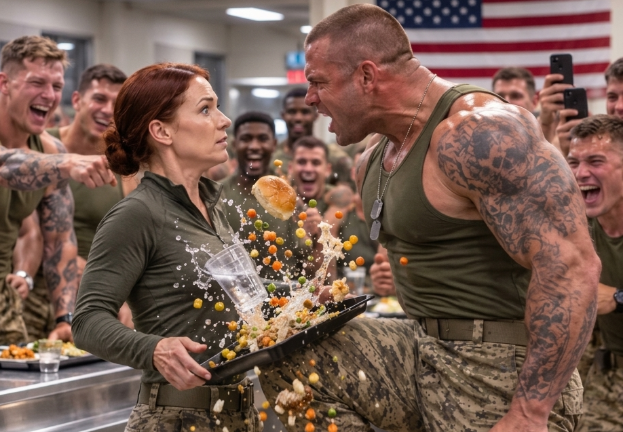
He grabbed my arm in front of his junior Marines, threatening to have me arrested for trespassing in the military dining hall !!
PART 2
I watched confusion wash over Staff Sergeant Callahan’s face. He had expected me to stumble forward, to yelp, to show panic.
Instead, his combat boots actually skidded slightly on the polished linoleum. He pulled harder, his thick biceps straining against the fabric of his desert camouflage.
It was like trying to drag a statue bolted to the deck. My feet remained planted exactly where they were.
I kept my center of gravity perfectly balanced. I didn’t need brute strength to defeat him; I just needed leverage.
He let out a frustrated grunt, throwing his full body weight backward. The muscles in his neck corded tightly as he strained.
I didn’t give him an inch. I had spent two decades mastering the exact mechanics of standing my ground.
Callahan finally released my arm, his chest heaving with exertion. Sweat beaded on his shaved scalp and rolled down his temples.
His verbal assaults hadn’t worked. His physical intimidation had failed completely, leaving him visibly shaken.
He stepped back, his jaw clenching and unclenching rapidly. He was a bully realizing his entire playbook was utterly useless.
The dining facility had gone as quiet as a tomb. Every Marine in the room was watching the trainwreck unfold in slow motion.
A Private First Class named Kenneth Tors leaned over to his buddy. He whispered, asking if I was genuinely just refusing to move.
Lance Corporal Austin Fischer nodded slowly, his fork frozen halfway to his mouth. He murmured that he had never seen anything like it.
They didn’t understand the tactical training required to maintain that stance. They only knew their aggressive senior NCO was completely failing to move a woman in a gray pullover.
Callahan was running out of options. His face was slick with sweat, his pride wounded and bleeding in front of his subordinates.
“You know what?” he breathed, his voice taking on a desperate edge. “You’re not eating in this facility today.”
He threatened to call the military police again. He promised they would escort me out in cuffs and cite me for trespassing.
The two young Lance Corporals behind him shifted nervously. The dynamic had changed, and they could feel the danger radiating in the air.
“Sergeant,” one of them whispered hesitantly, glancing at the silent crowd. “Maybe we should just shut it.”
Callahan snapped at him without looking back. His eyes remained locked on my face, searching for a weakness that simply didn’t exist.
“I’m not finished here,” Callahan growled. He stepped into my personal space again, trying to use the sheer weight of his physical presence.
He offered me two options. I could walk out with my dignity, or I could leave in handcuffs and embarrass my family.
I looked at him with steady, unblinking eyes. I didn’t feel anger or fear toward this man.
I only felt profound pity. He was a man walking blindly off a cliff, entirely unaware of the devastating drop ahead.
“Sergeant Callahan,” I said quietly. “You should stop talking now.”
“Or what?” he challenged, his voice rising again in a desperate bid for control. “What are you going to do about it?”
He mocked the idea of me calling a husband or a chaplain. He declared that nobody could help me now.
“I am the authority in this chow hall,” he proclaimed loudly. “My word is law in this space.”
He pointed sharply toward the exit. He demanded I get out immediately.
I adjusted my stance slightly. It was a minute shift, moving from a defensive posture to a stance of absolute command.
“I am going to get my lunch,” I said, my voice dropping into a tone that resonated through the silent room. “And you are going to step aside.”
Callahan blinked. For a fraction of a second, his absolute certainty visibly wavered.
But his toxic pride wouldn’t let him back down in front of his Marines. He reached for the radio on his belt.
“That’s it,” he snarled, his hands trembling as he gripped the black plastic. “You’re done.”
He keyed the microphone, preparing to make his final, fatal mistake. He was about to make a false official report.
Outside the dining facility, the autumn air was crisp and cool. Lance Corporal Tyler Brennan burst through the double doors, his hands shaking violently.
He fumbled with his cell phone, his thumb slipping on the glass screen. He had to type the battalion headquarters number three times before getting it right.
The staff duty line rang twice. It felt like an absolute eternity to the panicked young Marine.
“Battalion Staff Duty, Sergeant Pierce speaking,” a crisp, professional voice answered.
“Sergeant, this is Lance Corporal Brennan from Charlie Company,” he stammered, the words tumbling over each other. “You need to get the Command Sergeant Major down here right now.”
Pierce’s tone shifted immediately to high alert. “Whoa, slow down, Brennan. Is there a fire? A medical emergency?”
“It’s not a medical emergency, Sergeant,” Brennan said, pacing in tight, frantic circles on the concrete. “But it’s bad.”
He quickly explained that Staff Sergeant Callahan was physically restraining and threatening a civilian woman in the chow line.
Brennan took a ragged breath. “And Sergeant, I’m pretty sure the woman he’s harassing is General Margaret Thornton.”
There was a long, heavy silence on the other end of the line. The distant hum of base operations echoed through the phone.
“Say again, Lance Corporal?” Pierce asked carefully, his voice tight.
“General Margaret Thornton,” Brennan repeated, pressing the phone painfully hard against his ear. “The new Deputy Commanding General.”
He explained about the orientation photo and the matching memorial bracelet. He insisted he was ninety-nine percent sure of her identity.
“I’m going to verify this, Brennan,” Pierce warned, his voice dangerously low. “If you’re making accusations based on mistaken identity, there will be serious consequences.”
Brennan stood his ground. He urged Pierce to hurry, terrified of the career-ending lightning bolt about to strike his unit.
The sound of a chair scraping violently against the floor came through the phone. Pierce was already pulling up the General’s schedule.
“Oh my god,” Pierce whispered, the professional composure cracking.
He confirmed my schedule. He saw the notation about my personal physical fitness assessment and my planned lunch at the main facility.
“It’s her,” Brennan said, relief and terror warring in his chest. “I’m not crazy.”
Pierce ordered him to stand by and observe without interfering. He immediately began alerting the commanding officer.
Back inside the dining facility, the atmosphere had grown suffocating. Callahan’s thumb hovered over the transmit button of his radio.
Before he could speak into the mic, the air in the room seemed to shift. Every Marine present felt it in the pit of their stomach.
I drew my shoulders back just slightly. My spine straightened an additional inch.
“I suggest you reconsider that action, Sergeant,” I commanded softly.
This wasn’t a suggestion. It was a direct order delivered with the weight of twenty years of unyielding military authority.
Callahan’s hand visibly trembled. His thumb moved away from the button without his conscious permission.
“You are making a scene,” I continued, my voice low but incredibly penetrating. “You are violating the very discipline you claim to represent.”
I told him he was demonstrating a fundamental lack of understanding of his own position. I pointed out the terrible example he was setting for his subordinates.
“What are you?” he started to ask, confusion finally breaking through his blinding rage.
I raised a single hand. It was a simple gesture asking for silence, but the authority behind it was absolute.
“Do not speak,” I ordered.
I dismantled his entire argument piece by piece. I reminded him that the word ‘warrior’ was not a club to beat people with.
“A warrior is not someone who confuses strength with cruelty,” I explained, letting the words echo off the metal serving counters.
I told him a warrior understands that rank comes with responsibility. It is a burden to be carried, not a trophy to be displayed.
Callahan’s radio hung loosely in his grip. His face had drained of color, leaving him looking pale and suddenly very small.
I detailed every violation he had just committed. The physical assault. The unlawful orders. The attempt to file a false report.
“Those are serious offenses, Sergeant Callahan,” I said coldly. “Those are offenses that end careers.”
I gave him one final opportunity. I told him to lower the radio, step aside, and contemplate what it meant to be a leader.
Slowly, the fight drained completely out of him. He lowered the radio to his side, his arm hanging limply in defeat.
Just as he stepped back, the double doors of the dining facility crashed open.
Lieutenant Colonel Marcus Shelby burst into the room at a near sprint. He was the battalion commanding officer, and he looked terrified.
Right behind him was Command Sergeant Major Garrett Monroe. The massive, battle-hardened senior enlisted advisor looked like an avenging angel.
Two additional officers flanked them, their faces grim. The cavalry had arrived, and they were not there to save Callahan.
The entire dining facility snapped to rigid attention. The sudden movement of hundreds of Marines standing perfectly straight created a loud, synchronized crack.
Callahan tried to snap to attention, his movements jerky and uncoordinated. He opened his mouth to explain.
“Step away from the serving line,” Command Sergeant Major Monroe roared. “Now.”
Callahan shuffled sideways, his eyes darting frantically between the furious officers. He finally realized the magnitude of his error.
Lieutenant Colonel Shelby approached me with measured, highly respectful steps. He stopped and confirmed my identity with his own eyes.
“General Thornton,” Shelby said, his voice carrying clearly across the silent room. “We sincerely apologize for what has occurred here today.”
The revelation hit the room like a physical shockwave. Gasps were swallowed, and eyes widened in sheer disbelief.
I nodded slightly, acknowledging his words with calm grace. I suggested we step into his office to discuss the matter privately.
“But before we do,” I added, glancing at the trembling Staff Sergeant. “I believe your Sergeant Major has some matters to address.”
Monroe turned his terrifying focus onto Callahan. He stepped close enough that Callahan had to look up at him.
“Staff Sergeant Callahan,” Monroe growled softly. “You are relieved of your duties, effective immediately.”
He ordered Callahan to report to his office the next morning with a written statement. He promised the man his career was balancing on the edge of a knife.
Shelby gestured toward the exit, offering to escort me away from the chaos. I maintained my perfect composure as I walked past the frozen rows of Marines.
I didn’t smile. I didn’t look back to gloat. I simply carried the weight of command out the door.
Once I was gone, the tension in the room snapped. Conversations erupted in hushed, frantic whispers.
Monroe silenced them all with a single sweeping glare. He planted himself in the center of the serving line.
He ordered Callahan not to move or speak. Then he turned his wrath on the two terrified Lance Corporals.
He demanded their names and units. He ordered them to write detailed statements and report to his office at dawn.
Then, Monroe addressed the entire room. He told them they had just witnessed conduct unbecoming of a Marine.
“This is what happens when leadership forgets what it means to be a leader,” Monroe bellowed, pointing a thick finger at Callahan.
He promised the battalion would use this incident as a brutal example. He then ordered the remaining Marines to eat their lunch in orderly silence.
Over the next seventy-two hours, the investigation was utterly relentless. The military machinery moved with cold, calculating precision.
Statements were collected from forty-seven witnesses. The serving line was photographed and meticulously mapped.
By Friday morning, a formal disciplinary hearing convened in a small conference room at Battalion Headquarters. The evidence against Callahan was insurmountable.
Lieutenant Colonel Shelby sat at the head of the polished wooden table. Command Sergeant Major Monroe sat to his right, looking like a mountain of stone.
Callahan sat across from them, flanked by an appointed legal officer. The arrogant bully from the chow hall was completely gone.
The charges were read aloud. Assault on a federal officer. Abuse of rank and authority. Conduct unbecoming.
Callahan’s defense was nonexistent. He knew the evidence was overwhelming, and his spirit was broken.
When asked to speak, Callahan stared at his hands. He admitted he knew what he was doing was wrong, but did it anyway because he felt entitled.
It was a devastating confession. It proved he had chosen cruelty simply because he thought he could get away with it.
Shelby nodded gravely, prepared to deliver the sentence. But before he could speak, the heavy wooden door opened.
I walked into the conference room wearing my pristine dress blues. The stars on my collar gleamed under the fluorescent lights.
Callahan shot out of his chair, nearly knocking it over. His face was devoid of all color as he snapped to attention.
“At ease, Sergeant,” I said calmly. “Please sit down.”
Callahan slowly sank back into his seat. His hands gripped the edge of the table so hard his knuckles turned white.
I told him I wasn’t there to humiliate him further. I was there because it was my duty to ensure he learned the right lesson.
“You chose to judge me based on my appearance,” I stated firmly. “You chose to use your physical size to intimidate someone.”
I reminded him that he had done this in front of his subordinates. He had taught them that respect came from violence, not character.
I saw tears welling in Callahan’s eyes. He was trying desperately to hold them back through sheer force of will.
I recounted my own history as a young Captain in a remote combat zone. I explained what it truly meant to command Marines in danger.
“A warrior uses their strength to protect those who are vulnerable,” I told him, holding his gaze. “A warrior leads by character, not by fear.”
I warned him that he was becoming a toxic leader. If left unchecked, he would have destroyed the cohesion of every unit he touched.
I left the question of his future entirely in his hands. I challenged him to learn from the humiliation and grow from it.
Then, I sat in silence as Lieutenant Colonel Shelby delivered the crushing sentence.
Callahan was permanently reduced in rank from Staff Sergeant to Sergeant. His pay and benefits were immediately slashed.
He was removed from his prestigious billet. His new assignment was manual labor in the very dining facility where he had committed his offense.
He was placed on six months of strict probation. Any minor infraction would result in his immediate discharge from the Marine Corps.
Finally, he was ordered to undergo mandatory weekly mentorship with Command Sergeant Major Monroe. It was a grueling path to redemption.
Shelby made it clear these punishments were designed to rehabilitate, not destroy. The choice to rebuild was Callahan’s alone.
I stood to leave. Before walking out, I addressed him by his new, lower rank.
“Sergeant Callahan,” I said quietly. “I have seen many Marines recover from mistakes. The question is, which category will you fall into?”
I told him I believed he would make the right choice. Then I walked out, leaving him to face the ruins of his career.
By Monday morning, Sergeant Callahan reported to the scullery at 0600 hours. He wore his new, lesser chevrons.
The dining facility’s senior enlisted advisor, Gunnery Sergeant Vincent Monroe, greeted him without pity. He immediately put Callahan on the dishwashing station.
For a solid week, Callahan scrubbed massive industrial pots. He mopped greasy floors and cleaned out filthy ovens.
His soft hands developed thick calluses and chemical burns. His back ached from the brutal, unglamorous physical labor.
But as the days turned into weeks, something profound began to shift inside him. He started paying attention.
He watched the junior Marines working exhaustingly long hours just to keep the battalion fed. He realized how much he had taken their invisible labor for granted.
Every Friday, he reported to Command Sergeant Major Monroe for his mandatory mentorship session. They were grueling, emotionally exhausting meetings.
Monroe forced Callahan to dissect his own toxic behaviors. They analyzed the core values of the Marine Corps line by line.
Three months into his punishment, a breakthrough occurred. Callahan was assigned to train three new privates on sanitization protocols.
Instead of screaming at them, he spent three patient hours explaining the ‘why’ behind the rules. He taught them that their work directly impacted the health of their fellow Marines.
When he proudly relayed this to Monroe, the Sergeant Major simply nodded. It was the first sign of genuine, structural change in the man’s character.
“That is the difference between a leader and a bully,” Monroe told him. “A leader creates commitment through understanding.”
Shortly after, I invited Callahan to a casual dinner at my quarters. It was a small gathering of junior Marines I was personally mentoring.
Callahan arrived in his dress uniform, looking more terrified than he had on the day of the confrontation. I greeted him warmly at the door.
I introduced him to the group not as a failure, but as a Marine who was actively choosing to become better. I treated him with the same respect I afforded everyone else.
Later that evening, I pulled him aside. He immediately tried to apologize again for his horrendous behavior in the chow line.
I stopped him. I told him the apology wasn’t necessary anymore; his daily actions were doing the talking.
“I invested time in you because I saw potential,” I explained quietly. “Leaders who remember their own failures tend to be compassionate to the failures of others.”
Tears filled his eyes again, but this time they were tears of profound gratitude. He promised he wouldn’t waste the second chance.
Six months finally passed. Callahan’s probation period officially ended with a spotless record of exemplary conduct.
His performance in the scullery had been transformative. The junior enlisted Marines now looked up to him as a genuinely reliable leader.
During his final Friday session with Monroe, the Sergeant Major pulled a small wooden box from his desk. Inside rested a heavily worn commander’s coin.
“This represents commitment,” Monroe said, handing the precious artifact to Callahan. “It represents service to those under your command.”
Monroe told him he had successfully learned the hardest lesson. His rank was not about him; it was about the people he served.
Callahan accepted the coin with shaking hands. He swore to carry it as a permanent reminder of the choice he had made to change.
Three weeks later, I returned to the Camp Sterling dining facility for a routine inspection. The atmosphere was calm and orderly.
Sergeant Callahan was working the serving line. When he saw me, he didn’t freeze or panic; he simply continued serving his Marines with quiet professionalism.
I stopped across the counter from him. I extended my hand, and he shook it with a firm, respectful grip.
“I’m impressed with your progress, Sergeant,” I told him honestly. “Keep choosing to be a leader of character.”
“Thank you, General,” he replied, his voice steady and warm.
I walked away, finding a quiet table in the corner to eat my lunch. I watched as Callahan turned his attention to a nervous young private.
Callahan spoke kindly to the boy, offering extra vegetables and explaining the importance of good nutrition in the field. The private smiled, visibly relaxing under the Sergeant’s care.
I took a bite of my salad and nodded to myself. The arrogant bully was dead, replaced by a true warrior.
I opened my heavy green notebook, the pages filled with administrative details and unit readiness reports. I found the section dedicated to personnel development and uncapped my pen.
I made a single, carefully worded entry regarding Sergeant Callahan’s remarkable progress. I noted his successful completion of probation and his exemplary conduct on the serving line.
Then, I closed the notebook and set it aside. I simply sat there, eating my lunch in the quiet hum of the busy facility.
I was surrounded by hundreds of Marines who were quietly observing our interaction. They were no longer watching a toxic display of dominance; they were learning what true leadership looked like.
The massive military base continued its endless, grinding operations outside the reinforced windows. Duty rotations changed, convoys moved, and training recommenced in the crisp autumn air.
But inside the dining facility at Camp Sterling, something fundamental and profound had shifted forever. A stubborn, arrogant Marine had been completely broken down and successfully rebuilt.
An unyielding military institution had chosen to invest heavily in one man’s redemption instead of discarding him. A failing leader had learned that the greatest victories are not won through raw authority.
He had learned they are won through the deliberate transformation of those who come under your command. This was the defining story that would be whispered through the enlisted ranks for years to come.
It would not be told as a dark warning about what happens to someone who makes a foolish mistake. It would be shared as a powerful inspiration.
It showed what could happen when an institution chose to invest in the genuine growth of its people. It reminded every young Marine that true redemption was always possible.
It proved that second chances could be earned through grueling labor and undeniable humility. It cemented the fact that unbreakable character was the only true measure of a leader.
In the long, demanding years that followed, Sergeant Callahan would faithfully carry the weathered coin Command Sergeant Major Monroe had given him. He would not display it on his uniform or boast about its origins.
He would carry it in his heart and in his daily memory. He would apply its heavy lesson to every single decision he made about how to lead his subordinates.
He would always remember the crushing humiliation in the center of the dining facility. He would remember the absolute shame of his own toxic arrogance.
Most importantly, he would remember the incredibly difficult choice he made to change his life. He would pass that hard-earned wisdom on to every young Marine he ever led.
He ensured that the cycle of redemption and continuous growth survived through the ranks of the institution he served. He became the exact kind of leader the Marine Corps desperately needed.
Because he finally understood the true, unforgiving measure of a warrior. It was never about possessing the brutal strength to dominate others.
It was about finding the profound strength to humble oneself. It was about having the courage to learn, to grow, and to become someone truly worthy of the rank they wore.