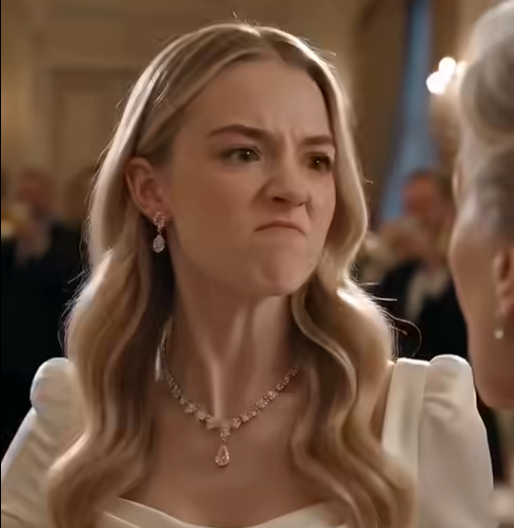
The slap hit Margaret Bennett across the face like a gunshot.
Two hundred and fifty guests stopped breathing.
Her head snapped sideways. Heat bloomed across her cheek. A champagne flute shattered somewhere behind her, and the band cut off mid-song.
When Margaret turned back, her daughter-in-law Tiffany was still standing over her in white satin, one hand raised, diamonds flashing beneath chandeliers Margaret had paid for.
Tiffany did not look ashamed.
She looked offended that Margaret had made her do it.
“You’re ruining the atmosphere,” Tiffany said coldly. “You should leave.”
Margaret’s name was Margaret Bennett. Sixty-two, widowed, and until that night, she had believed that sacrifice was the purest form of love.
She had spent $45,000 on this wedding.
The original plan had been modest. Eighty guests. A family dinner. A local quartet.
Then Tiffany took control.
Eighty guests became 250. A restaurant became a private estate. Simple flowers became imported roses and orchids flown in from three countries. She demanded luxury transportation, premium wine, a designer cake, custom favors, professional lighting, and a farewell brunch.
Every time Margaret tried to set a limit, Daniel came to her alone.
“Please, Mom. It’s only one day.”
“She’s under pressure.”
“Can you let it go one more time?”
So Margaret let it go. She emptied her savings, canceled the trip to Scotland she and her late husband Thomas had spent twenty years planning, and finally sold six acres of land Thomas had inherited from his father — land that had been in the family for four generations.
The day she signed the sale papers, she cried in her car until the windows fogged.
She told herself it was for Daniel.
The reception looked flawless. Chandeliers blazed above white linen tables. Champagne cost more per bottle than her weekly groceries. And then Tiffany discovered the bar was not serving Laurent Reserve — a rare imported champagne at nearly two thousand dollars a bottle.
She had added it for her father’s toast.
Margaret had removed it.
Tiffany marched across the ballroom, her parents following with expressions that were not embarrassed. They looked entertained.
“The bar manager says the Laurent Reserve isn’t being served,” Tiffany announced.
“That’s correct,” Margaret said.
“Tell them to put it on your card.”
“No.”
Tiffany blinked. “This is my wedding.”
“And I have already paid more than enough.”
Her voice rose. Nearby conversations faded. “My father specifically requested that bottle.”
“Then your father is welcome to purchase it.”
Richard Sterling folded his arms and offered nothing.
Tiffany’s polished smile vanished. “You’ve resented this wedding from the beginning.”
“I questioned the expenses.”
“You tried to control everything.”
“I paid for everything.”
The ballroom went painfully quiet.
Daniel stood near the dance floor, pale and motionless. His boutonniere trembled slightly against his tuxedo. Margaret waited for him to speak.
He did not.
Tiffany noticed his silence, and it made her crueler.
“You’re nothing but a resentful old woman with money,” she said. “You promised us a perfect wedding.”
“I promised to help. You simply kept asking until there was almost nothing left.”
“You’re destroying my wedding!”
Behind Tiffany stood flowers Margaret had purchased. Above her hung chandeliers in a ballroom Margaret had rented.
“I have given enough,” Margaret said. “The answer is no.”
Tiffany’s hand moved without warning.
The slap cracked across Margaret’s face.
The room went so silent that the sound of the impact seemed to echo.
Margaret looked toward Daniel.
“Tiffany…” he whispered.
Too quietly. He did not move. He did not demand an apology. He simply stood there while his wife stared at Margaret as though she were the problem.
Something inside Margaret closed.
Not shattered. Closed.
She picked up her purse, stood straight, and crossed the ballroom alone. Inside the restroom, she locked the door and faced the mirror. A red handprint was forming across her cheek.
She saw a widow who had sold part of her husband’s inheritance for people who could not offer her basic dignity.
Then she removed her phone.
Every major contract was in her name: the ballroom, the bar, the band, the transportation, the dinner service, the honeymoon suite, the farewell brunch.
The venue manager, Mr. Ellis, answered on the second ring.
“Mrs. Bennett? Are you all right?”
“No,” she said. “But I will be.” She looked at the handprint in the mirror. “Activate the cancellation clause. End every service connected to my account.”
A pause. “That will stop the bar, the band’s extended set, the transportation package, the honeymoon suite, and tomorrow’s brunch.”
“I understand.”
“Are you certain?”
She thought about Thomas’s land. About Daniel’s silence.
“End everything.”
Less than ten minutes later, the wedding began to die.
Bartenders corked bottles mid-pour. Musicians unplugged equipment. Drivers outside received cancellation notices on their phones. Confusion spread through the ballroom like smoke.
Tiffany cornered Mr. Ellis near the dance floor as he approached with a leather folder.
“What is happening?”
“Services authorized under Mrs. Bennett’s account have been terminated.”
“You can’t do that!”
“I can, and I have.”
Richard pushed forward. “Put everything on my daughter’s account.”
Mr. Ellis opened the folder. “I’m afraid that account does not exist.”
Tiffany’s expression shifted — just slightly. But Margaret, who had returned to the ballroom doorway, saw it.
Mr. Ellis removed several pages. “These supplemental authorizations were submitted three weeks ago. They transfer outstanding charges from Mrs. Bennett’s account to a property-backed line of credit.”
Margaret’s stomach tightened. “I never authorized a line of credit.”
“I know,” Mr. Ellis said.
Richard’s voice sharpened. “This is neither the time nor the place.”
Mr. Ellis looked directly at him. “Actually, Mr. Sterling, this is exactly the place.”
He turned one document toward Margaret. At the bottom was her name. The signature looked almost perfect — but Thomas had taught her to make the final stroke of the B in Bennett curve backward. This one curved forward.
Someone had forged her name.
A murmur swept through the room like a wave.
Richard’s jaw tightened. “This is a misunderstanding.”
Daniel finally moved.
He walked forward and removed the white boutonniere from his lapel. Hidden beneath it was a small black microphone.
The ballroom erupted in whispers.
“Mom,” Daniel said, his voice unsteady, “I found emails on Tiffany’s laptop six weeks ago. Her father’s company created the fake credit line. They planned to drain your savings, force you to sell the remaining land, and buy it through a shell company.”
Richard laughed — but the sound was brittle. “That is absurd.”
Daniel faced him. “Hawthorne Holdings.”
The name hit Margaret like a second slap.
That was the company that had purchased her six acres.
“Hawthorne is controlled by Richard Sterling,” Daniel said. “He wants the remaining twenty-two acres for a private development project. I went to your attorney and the financial-crimes division six weeks ago. They told me not to confront anyone until we had proof.”
Margaret’s cheek burned.
“And while you waited for proof,” she said quietly, “you watched her strike me.”
His eyes filled. “I didn’t know she would do that.”
“But you still said nothing.”
Daniel lowered his head.
He had worn a wire. He had helped build the case. But when the moment demanded courage rather than strategy, he had still failed her.
Tiffany suddenly laughed — high and breathless, the laugh of someone whose composure had finally cracked.
“You think you’ve won?” she said. “The land is already ours. The sale closed four days ago. You signed everything. The six acres belong to Hawthorne, and once the loan defaults, the rest will follow.”
Richard seized her wrist. “Stop talking.”
But panic had broken her restraint entirely.
Mr. Ellis looked toward the entrance. “That,” he said quietly, “was the statement they needed.”
The double doors opened.
Two uniformed officers entered alongside Detective Lena Ortiz, Margaret’s attorney Samuel Price, and an elderly man carrying a weathered leather case.
Richard went gray.
Detective Ortiz stepped forward. “Richard and Tiffany Sterling, you are being investigated for forgery, conspiracy, attempted elder financial exploitation, and fraudulent property transfer.”
Richard looked around wildly. “This is a private family matter.”
“No,” she said. “It is not.”
Samuel opened his leather case and removed a sealed document bearing Thomas’s signature.
“There is one more matter,” he said gently. “Thomas anticipated that someone might pressure you into selling the family land. Twelve years ago, he placed the property into a protective trust. You could negotiate a sale, but no transfer became final without approval from all three trustees.”
Margaret whispered, “Three?”
“You were one. I was the second.”
“And the third?”
A familiar voice answered from behind the officers.
“I was.”
The elderly man stepped forward.
Margaret’s heart stopped.
He was thinner than she remembered, and he walked with a cane, but she knew those eyes. Thomas’s younger brother, Edward — gone for twenty-five years after a bitter family dispute. They had been told he died overseas.
Yet there he stood.
Alive.
Edward looked at Richard Sterling. “I never approved the sale.”
Samuel closed the file. “Therefore, Hawthorne Holdings owns nothing. The transfer is void, the money remains in escrow, and the remaining land was never at risk.”
Tiffany’s knees buckled. Richard turned toward the exits, but the officers were already there.
As an officer moved toward Tiffany with handcuffs, she twisted toward Margaret one last time.
“You ruined my life!”
Margaret met her eyes without flinching.
“No,” she said. “You simply spent too much time believing my love made me powerless.”
An officer took Tiffany’s wedding ring as evidence. Richard was read his rights in front of 250 guests, his expensive suit suddenly looking like a costume.
Daniel stood in the center of the ballroom, alone, his wire still taped beneath his shirt.
“Mom,” he said. “I’m sorry. I should have told you the moment I found out.”
Margaret touched the swelling on her cheek. “You helped stop them. I won’t forget that.” She paused. “But you also let her hit me and said nothing. I won’t forget that either.”
Daniel nodded. He didn’t argue. That, at least, was something.
Edward offered her his arm.
“I believe we have a great deal to talk about,” he said.
Margaret looked at him — this ghost of Thomas, this piece of family she had believed was lost forever — and felt something loosen in her chest that had been locked tight for years.
“We do,” she said.
Beneath the chandeliers Tiffany had thought she owned, Margaret walked out on the arm of the one person she hadn’t known to look for. Behind her, the wedding ended not with a toast, but with handcuffs clicking shut and Richard Sterling being escorted past the flowers, the crystal, and the imported champagne he had never intended to pay for.
The band, no longer under contract, packed up their instruments in silence.
Nobody played them out.