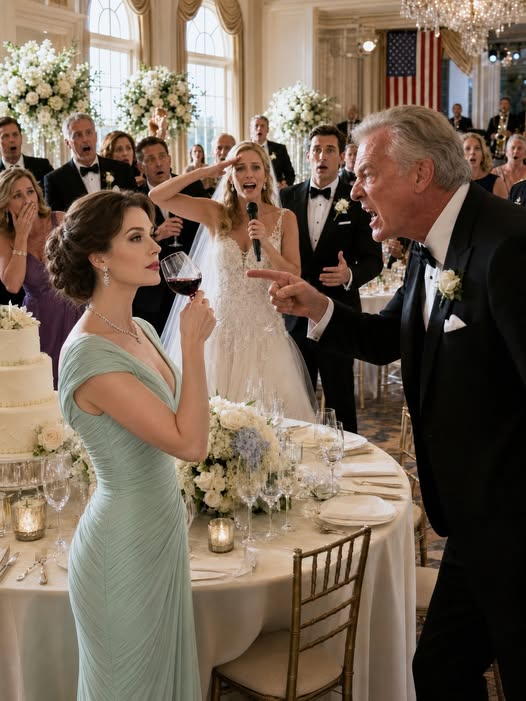
Twenty-one years after my father kicked me out of the house, I ran into him at my nephew’s wedding. He looked at me with disdain and sneered, ‘If it weren’t out of pure pity, nobody here would have invited you.’ I calmly took a sip of my wine and just smiled. A moment later, the bride grabbed the microphone, saluted sharply in my direction, and announced to the crowd, ‘Everyone, please raise your glasses for a toast to Admiral..
PART 1
The first thing I noticed when I entered the St. Aurelia Hotel ballroom was the smell of wealth.
Not fresh money or clean luxury, but something heavier—champagne bubbles, white orchids, beeswax candles, expensive perfume, polished stone floors, and the faint buttery scent of lobster drifting from silver trays along the walls. Hundreds of guests filled the room beneath crystal chandeliers, moving as though the evening had been carefully staged for their comfort. Women in silk gowns laughed softly with their heads tilted back. Men in tuxedos barely touched their drinks. Staff in white gloves glided between them carrying caviar, smoked seafood, and delicate canapés I couldn’t identify.
I stood at the entrance in a plain navy dress from a clearance rack, worn heels, and no jewelry except a small silver bracelet hidden under my sleeve.
For a second, I thought about leaving.
Then I saw my nephew.
Calder Rowe stood under an arch of white roses beside his bride, speaking with guests near the head table. He had his mother’s eyes, but not her weakness. When he saw me, his expression shifted instantly—relief, real and unfiltered, like he had been holding his breath until that moment.
“Aunt Maren,” he mouthed.
I lifted my hand slightly.
It had been twenty-one years since I last stepped into a Rowe family event. Not birthdays, not funerals, not galas. Not even my grandmother’s memorial—I had stood outside in the rain instead, listening to the service from beyond the walls.
The last time I saw my father, Alden Rowe, he stood in the doorway of our old house with my two suitcases at his feet. Rain poured down the gutters. My mother stood behind him, pressing a handkerchief to her mouth, more embarrassed than devastated. My brother Griffin leaned against the stairs, smiling like he was watching something he had been waiting for.
I was nineteen.
“You are a disgrace,” my father said. “You were meant to marry Easton Bell. That was your responsibility.”
“I don’t love him,” I replied.
“You were not raised to chase love. You were raised to fulfill duty.”
“I won’t do it.”
That was the moment something in him shut permanently.
He threw my bags into the rain.
“Then go,” he said. “Become nothing. And don’t come back when the world shows you your worth.”
Griffin laughed behind him.
“You’ll never be anything without this name,” my father added.
I didn’t cry.
I just left.
For twenty-one years, those words stayed with me—not as truth, but as weight I learned to carry.
Now I was back.
The wedding was everything my father valued—gold-accented cake, ice sculptures, string music, champagne fountains, and guests whose names appeared in financial headlines and political columns. Alden Rowe had built his entire identity around rooms like this.
I found my table near the back, beside a decorative palm and a speaker disguised with flowers. Table 42. Deliberately forgotten space.
The place card read simply: “Maren Rowe.”
No title. No escort. No acknowledgment.
Perfect.
I had just sat down when the room subtly shifted. Conversations softened. Heads turned. A few guests began whispering.
I followed their gaze.
My father stood across the room.
Alden Rowe still carried himself like a man who expected the world to adjust for him. Silver hair, perfect tuxedo, crystal glass in hand. But when his eyes met mine, something in his expression fractured—just briefly.
Shock.
Then control returned.
Griffin stood beside him, smiling already.
“Well,” he said loudly, “the ghost showed up.”
My father didn’t smile. His eyes scanned me slowly.
“Maren,” he said. “I wasn’t sure Calder’s sentimentality would extend this far.”
I lifted my glass. “Hello, Alden.”
A nearby guest gasped at the name.
Griffin chuckled. “Still dramatic, I see.”
My father stepped closer, close enough that his voice could reach only me—but loud enough that others leaned in anyway.
“Pity got you invited,” he said. “Nothing else. You don’t belong here.”
Silence gathered around us, sharp and expectant.
I looked at him.
For a moment, I wasn’t in this ballroom. I was back in rain-soaked asphalt, suitcases in puddles, nineteen years old and erased from a family.
Then I took a slow sip of wine.
Cold. Bitter. Perfectly ordinary.
I smiled.
And my father, for the first time, didn’t know what he was looking at.

Part 2
Griffin laughed first—because he had always needed permission from himself before being cruel.
“Still dramatic,” he said. “I told Calder this was a mistake. Weddings are supposed to be about happiness.”
A man in a gray tuxedo beside him chuckled into his napkin. A woman in pearls glanced between my dress and my empty ring finger, as though worth could be measured in fabric and jewelry.
I set my wineglass down carefully.
“Calder invited me,” I said. “So I came.”
My father made a faint, dismissive sound. “Calder is young. Sentiment makes young men careless.”
“He’s thirty,” I replied.
“He’s still young enough to believe blood excuses absence,” he said.
That line landed closer than I wanted it to—not because it was fair, but because Calder had once asked me something similar in a letter I had never forgotten.
He had found me through an old post office box I kept for formal correspondence I never sent home. His first letter was handwritten—thick paper, careful ink, no corporate polish.
“Aunt Maren,” it began, “I don’t know what happened between you and my father, but nobody will tell me the truth.”
I had read that sentence twice.
He wrote that he remembered me from one afternoon when he was six—when I took him to the park because his mother had a migraine and the men were in a meeting. He remembered the swing. The blue popsicle. My voice telling him, never confuse loud people with strong ones.
He remembered it. I had not.
His letter ended simply: he was getting married in July, and he wanted at least one person there who understood that the Rowe name and the Rowe truth were not the same thing.
That was why I came.
Not for my father. Not for Griffin. Not for forgiveness. And not to reclaim anything that had already been taken.
I came because one child had held onto one sentence for twenty-four years.
My father did not know that. He only saw an opening.
“So tell us,” Alden said, lifting his glass slightly, “what do you do now? Office work? Nonprofit? Teaching? I heard something vague years ago—government, perhaps. Low level, I assume.”
Griffin leaned toward the table. “She always liked pretending rules made her important.”
I could have answered.
I could have named places that would have changed the way every person in that room looked at me. I could have listed offices, operations, briefings, waters they would never see, decisions made in silence where no applause existed.
Instead, I said, “I keep busy.”
Griffin laughed. “That’s what unemployed people say.”
“No,” I replied calmly. “It’s what busy people say.”
His smile tightened.
My father studied me more carefully now. I could feel it—the shift. The irritation of a man who couldn’t file me into a category that made him comfortable.
He had expected broken. Small. Grateful.
Not this quiet steadiness.
Alden leaned in again. “Don’t confuse Calder’s invitation with reconciliation. You chose to leave this family.”
“You threw my bags into the rain.”
“You refused your responsibility.”
“You tried to sell my life,” I said evenly.
A few guests shifted uncomfortably.
Griffin’s voice dropped. “Careful.”
“I am,” I said.
My father’s jaw tightened, as though swallowing something sharp. Then his eyes dropped to my wrist.
The bracelet had slipped out from my sleeve.
Thin. Simple. Engraved with coordinates that meant nothing to anyone in that room.
Except him.
His gaze lingered.
“What is that?” he asked.
“A reminder,” I said.
“Of what?”
“That storms end.”
For the first time, he had no immediate reply.
A burst of laughter came from the head table, breaking the tension. Calder was speaking to his bride, Liora Vance, and attention drifted away from us.
Liora was striking—not in the way the room was designed to define beauty, but in the way she held stillness. She didn’t perform softness or status. She simply existed with quiet control, like someone used to pressure that didn’t come from chandeliers.
And I recognized it.
Not from weddings.
From something else.
Brighter rooms. Sterile lights. Early mornings. Briefings. A young officer standing alone while people tried to bury her voice under authority she refused to accept.
My hand tightened slightly around my glass.
Liora suddenly turned her head.
Her eyes met mine.
At first, nothing.
Then everything changed.
The color drained from her face.
Her posture straightened instantly. Her hand, resting near Calder’s, stiffened against the tablecloth.
Calder leaned in. “Liora?”
She didn’t answer.
She was staring at me like she had seen something she was never supposed to see again.
My father followed her gaze, then frowned. “What is wrong with her?”
Griffin muttered, “What’s going on with the bride?”
I didn’t respond.
Across the room, Liora slowly stood.
The string quartet faltered mid-note.
And for the first time that night, I felt something long buried begin to surface—something my family had never been prepared to face.
Part 3
Before Liora could take a step, a coordinator in a black dress hurried to the head table and leaned in to whisper about timing. Calder gently touched her elbow. She blinked sharply, as if forcing herself out of a memory, then slowly sat back down.
The room started breathing again.
My father watched her for a moment longer, then turned back to me.
“You’ve unsettled the bride,” he said, as though I had brought dirt into his polished world.
“I haven’t spoken to her.”
“Your presence is enough.”
It was the same old pattern—turn discomfort into my fault before anyone examined the truth.
Griffin finished his drink in one swallow. “Maybe you should sit down somewhere less… noticeable.”
I gave a small smile. “Table 42 is already doing that job.”
“Then stay there,” he said.
I walked past him.
He caught my arm.
Not enough to bruise—Griffin never risked that in public—but his grip was familiar. The same controlling hold he used when we were younger, trying to silence me at family dinners.
The old version of me would have pulled away immediately.
Instead, I looked at his hand.
“Let go,” I said quietly.
He scoffed. “Or what?”
I met his eyes.
“Or you’ll remember this moment longer than you want to.”
Something in my tone shifted his certainty. His fingers released.
My father watched with growing irritation.
“You’ve learned arrogance,” he said.
“No,” I replied. “I learned boundaries.”
I returned to Table 42 and sat with my back to the wall. Some habits never leave you. Even in a ballroom wrapped in luxury, I still scanned exits, service doors, blind spots, the man near the north wall touching his earpiece too often, the aide watching the room instead of the stage.
Not fear. Awareness.
The cost of that awareness had been years of silence and survival.
At my table, three distant relatives treated me like a rumor that had finally taken form.
Petra offered a tight smile. “Maren. I wasn’t sure you’d come.”
“Neither was I.”
Her husband focused intensely on buttering his bread, avoiding eye contact entirely.
Their daughter leaned forward. “So where have you been all these years?”
Petra hissed her name under her breath.
“It’s fine,” I said. “Away.”
“Where?” she pressed.
“Different places.”
“That sounds mysterious.”
“Mostly paperwork and bad coffee.”
Cole let out an unexpected chuckle. Petra shot him a look sharp enough to cut glass.
At the front, Alden stepped up to the microphone. The lights dimmed slightly. Conversations faded. Glasses lowered.
He began speaking about legacy, family, and continuity, his voice polished and practiced.
I listened without reacting.
He spoke of the Rowe name as if it were a brand, a structure, an inheritance of superiority. Calder was framed as the next heir. Liora as a “welcome addition,” a phrase that sounded kind but carried ownership beneath it.
Then his gaze drifted toward the back of the room.
“There are those,” he said, “who mistake distance for dignity. But tonight we honor those who remain loyal to something greater than themselves.”
A few heads turned toward me.
Sloane whispered, “Is he talking about you?”
“Yes,” I said.
“That’s horrible.”
“That’s Alden.”
The speech continued, Griffin smiling beside him as if cruelty were a family tradition.
As Alden praised loyalty, I remembered the night I was thrown out.
Rain-soaked pavement. A duffel bag in a puddle. A bus station lit in flickering fluorescent white. Cold coffee. Wet socks. Doors opening and closing all night like the world didn’t know what to do with me.
At dawn, I had walked six blocks to a small office between a tax shop and a pawn store. A flag hung outside, heavy with rain.
I hadn’t gone in because I was strong.
I went in because I had nowhere else left to stand.
A woman behind the desk had asked, “Can I help you?”
And I had said, “I need a place where my father doesn’t get to decide who I am.”
She had studied me for a long moment.
Then slid a form across the desk.
That was the beginning they never saw coming.
Alden finished to polite applause. He raised his glass, smiling like a man blessing his own reflection.
Then he turned to Liora.
“Say something,” he said. “Something sweet.”
A few guests laughed softly.
Liora stood.
This time, no one stopped her.
She took the microphone—but didn’t look at him. Her eyes moved across the room until they found mine again.
Her jaw tightened.
Her bouquet trembled once.
Then she handed it to Calder, stepped forward, and straightened her posture.
The ballroom went so silent I could hear the champagne fountain.
Liora lifted her hand to her temple.
A perfect salute.
My breath caught.
Then her voice rang out through the speakers, clear and steady.
“Ladies and gentlemen, please rise for a toast to Rear Admiral Maren Rowe.”
A glass shattered somewhere near the front.
Part 4
For a full second, the ballroom didn’t move.
The declaration hung in the air like a signal flare no one knew how to answer.
Rear Admiral Maren Rowe.
I had heard my name spoken in secure rooms, on naval decks, inside briefing spaces where everything was controlled and nothing was accidental. I had heard it with respect, urgency, discipline, and sometimes resentment.
But never like this.
Never beneath chandeliers. Never in front of my father, who stood frozen with his mouth slightly open, unable to find words.
Then Liora spoke again.
“Twenty-one months ago, my career was nearly destroyed by a fabricated report and a sealed investigation I was not meant to survive. One officer placed her own standing between me and the people trying to erase the truth.”
A ripple of sound moved through the room.
My father went pale.
Griffin turned toward me so fast his drink sloshed over the rim of his glass.
But Liora’s hand remained steady in her salute.
“She had no personal connection to me. No obligation. Only the knowledge that the evidence was being buried and that a young officer was being punished for refusing to be convenient.”
Calder was staring at me now, his expression shifting as pieces of understanding began to fall into place. Not everything—yet—but enough to change how he saw me.
At the front of the room, three people rose almost simultaneously.
Senator Mae Whitcomb stood first, followed by Federal Judge Callan Reed. Then Harlan West, a defense industry executive my father had spent years trying to impress.
Their chairs scraping against marble broke the silence.
Then more people stood.
And more.
A wave of rising bodies spread across the ballroom until nearly everyone was on their feet. Guests who had barely noticed me earlier now faced forward, applauding, lifting glasses, reacting as if they were only now seeing clearly.
The sound swelled—clapping, rising, filling the chandeliers, the walls, the ceiling of flowers.
A standing ovation filled the same room my father had built to display his influence.
And none of it belonged to him anymore.
I stayed seated a moment longer than expected.
Not from hesitation.
But from the strange, unfamiliar weight of finally being acknowledged in a place that had once been designed to erase me.
Then I stood.
I gave Liora a small nod in return—no formal salute. Civilian space. Old discipline. Different rules.
Her eyes were wet, but she didn’t break. She looked like I remembered her: standing in a corridor long ago, holding a file that had nearly ended her career while she refused to disappear quietly.
I hadn’t helped her out of pure kindness.
I had recognized her.
The look of someone being punished for refusing to fit into someone else’s design.
Alden stepped back from the microphone.
For the first time, he had nothing to say.
Griffin leaned toward him. “Dad,” he said quietly.
It sounded almost like fear.
Liora lowered her hand, but her posture didn’t change.
“I ask everyone here,” she said, “to honor a leader who taught me that authority without integrity is decoration—but courage with discipline can change a life.”
The applause returned, louder than before.
At my table, Petra wiped her eyes. Sloane stared at me as though I had become something she couldn’t categorize. Cole whispered, “My God.”
But I didn’t feel victory the way people expect it to feel.
It was quieter than that.
Colder.
Clearer.
Like standing on a ship after a storm and realizing the water behind you is full of everything that didn’t survive.
My father’s version of the world hadn’t been destroyed by force.
It had collapsed under the weight of being named out loud.
When the applause finally faded, Liora turned to Calder and spoke softly off-mic. He nodded, and together they walked down the aisle between the tables.
The crowd parted instinctively.
My father stepped into their path.
“Liora,” he said, voice strained now, “this must be a misunderstanding.”
She stopped.
When she looked at him, there was nothing soft left in her expression.
“No, Mr. Rowe,” she said. “There was a misunderstanding. It was yours.”
The room heard it all.
Alden swallowed. “You should have told us you knew Maren.”
Liora’s eyes shifted briefly toward me.
“I knew Rear Admiral Rowe,” she said. “I didn’t know I was speaking to the family that abandoned her.”
Griffin snapped, “This is a wedding. Show some respect.”
Liora met his gaze.
“I am.”
Calder stepped forward beside her.
“I invited Aunt Maren because I wanted her here,” he said. “Not as pity. Because she mattered.”
Alden’s composure finally cracked.
“Calder, you don’t understand the history—”
“I understand enough,” Calder interrupted.
The silence that followed was heavy enough to change the shape of the room.
My father looked between all of them, control slipping from his grasp in real time.
Then he made his second mistake.
He turned and walked straight toward me.
Part 5
Alden walked between the tables with Griffin just behind him, both of them now wearing polite smiles.
That was always the more dangerous version of them.
Outright cruelty is easy to confront. It is the softened cruelty—wrapped in charm—that does the real damage.
Guests pretended not to look, which meant everyone was watching.
My father stopped in front of me and lowered his voice, shaping his expression into something almost warm.
“Maren,” he said, “this is quite the surprise.”
I didn’t respond.
He gave a small, practiced laugh—the kind he used when bad news needed to sound like opportunity.
“You could have told us about something like this. This achievement… it’s remarkable.”
I studied him for a moment.
“You didn’t ask.”
His jaw tightened slightly.
Griffin stepped in quickly. “We just didn’t know, Maren. You can’t really blame us for that.”
“I can blame you for ridiculing what you never cared to understand.”
Color rose in his face.
Alden lifted a hand in a calming gesture, as if addressing a tense meeting.
“This isn’t the time for resentment,” he said.
“No,” I replied evenly. “It’s my nephew’s wedding.”
“Exactly. So let’s handle this properly.”
There it was again—properly. In his vocabulary, it always meant silence from others and comfort for himself.
He leaned closer.
“We should talk later, privately. There are opportunities here. Your expertise could be… useful. We have several partnerships, security contracts, advisory roles. This could be mutually beneficial.”
I almost laughed.
Not because it was absurd—but because it was predictable.
Minutes ago, I was beneath him. Now I was a “resource.”
Griffin nodded quickly. “The Rowe Group is expanding. With your background, there could be consulting positions. Of course, paid appropriately.”
“Appropriately,” I repeated.
He fell silent immediately.
My father pressed on. “We are still a family.”
I glanced toward the head table. Calder stood with Liora, still holding her hand, his expression tense but resolute.
“No,” I said. “Calder is family. You are history.”
Alden’s face tightened.
For a moment, the mask slipped.
“You’ve always had a talent for disrespecting me,” he said quietly.
A strange calm settled in my chest.
“I was nineteen when you threw me out in a storm.”
“You made your choice,” he replied.
“I refused to be traded.”
“You refused to serve your family.”
“I refused to marry a man twice my age so you could secure a deal.”
A few guests gasped.
Griffin hissed, “Lower your voice.”
I didn’t.
That made it worse.
Alden looked around and realized people were listening. Senator Whitcomb hadn’t sat down. Judge Reed watched without expression. Harlan West whispered to an aide, his eyes fixed on my father like he was reassessing a risk.
My father noticed.
And his tone shifted instantly.
“Maren,” he said more softly, “whatever happened, I am proud of you.”
The words landed empty.
Years ago, I might have believed them.
Now they felt like strategy.
“You are proud of the uniform,” I said. “Not the person who wore it.”
His mouth opened.
I continued.
“You are proud because the room stood. Because a title was spoken. Because it can be used to reflect back on you. But you were never proud when it cost you anything.”
Silence spread again.
I stepped closer—not threatening, just close enough that he couldn’t avoid hearing me.
“I was not proud to sleep in bus stations. You were not proud when I built myself from nothing you gave me. You were not proud when I worked through nights you never saw. You are only proud now because other people are watching.”
Alden looked smaller, though still composed.
Griffin swallowed. “People are watching,” he muttered.
“Yes,” I said. “That’s why you care.”
Liora appeared beside me before I noticed her move. Calder was on her other side. Without her veil, she looked less like a bride and more like someone standing her ground.
“Admiral,” she said softly, “are you all right?”
My father flinched at the title.
I looked at her and allowed myself a small, real smile.
“I am.”
Calder turned to Alden.
“I need you to step away from her.”
Alden blinked. “Excuse me?”
“This is my wedding,” Calder said firmly. “I invited her. If you insult her again, you leave.”
Griffin looked stunned. “You cannot be serious.”
Calder didn’t look away.
“I’ve never been more serious.”
Alden glanced around the room for support—and found none. The center of gravity had shifted, and he was no longer it.
The band tried to restart the music, uncertainly, but it died under the tension.
Then Judge Reed stepped forward and extended his hand to me.
“Admiral Rowe,” he said quietly, “it is an honor.”
My father froze.
That single sentence said everything he needed to hear.
Because it confirmed what he had always refused to consider—
that the room knew me in ways he never had access to.
Part 6
Judge Reed had aged since I last saw him, but his handshake was still steady and sure.
“Judge,” I said. “You’re looking well.”
“I look retired,” he replied. “There’s a difference.”
A few nearby guests let out small, relieved laughs, but the tension in the room didn’t fully disappear. The air still felt tight, like it could snap at any moment.
Senator Whitcomb approached next, followed by Harlan West, and then a senior official from the Department of Energy whose name I remembered my father once mentioning with obvious ambition. Each greeting was brief, formal, and quietly meaningful.
“Admiral Rowe, I still owe you for that Norfolk briefing.”
“My son serves under one of your former officers.”
“Your assessment last spring reshaped the entire procurement strategy.”
No one said anything excessive. People used to secure environments know how to speak carefully. But each sentence landed like another support being removed from beneath my father’s position.
Alden stood a few feet away, smiling stiffly with eyes that no longer matched his expression.
Griffin wasn’t smiling at all anymore.
The guests who had laughed at my dress earlier now looked anywhere except at me—the floor, their glasses, their plates.
I didn’t take pleasure in it the way I might have once imagined. Real consequences rarely feel cinematic. Up close, they are quieter, heavier, and strangely uncomfortable.
Calder touched my shoulder.
“Aunt Maren,” he said softly, “can we talk somewhere private for a moment?”
I nodded.
Liora came with us as we stepped into a smaller side room—cream walls, framed city photographs, and muted noise from the ballroom beyond. A tray of untouched appetizers sat on a table, and a pearl hairpin lay abandoned near the mirror.
Once the door closed, Calder exhaled and buried his face in his hands.
“I’m so sorry,” he said.
I stood by the window, watching taxi lights pass through the rain outside.
“You didn’t do anything wrong.”
“I brought you into this,” he said.
“You invited me to your wedding. They turned it into something else.”
Liora stepped closer, her composure finally breaking now that she didn’t need to hold it.
“I didn’t know who you were,” she said quietly. “I thought maybe… but Rowe isn’t uncommon, and you never spoke of family.”
“You were right not to assume.”
“I nearly dropped my glass when I saw you,” she admitted with a weak, breathless laugh.
“I noticed.”
Calder looked between us. “So you two actually know each other?”
Liora nodded. “Your aunt saved my career.”
I corrected gently, “You saved it. I just made sure the truth had somewhere to land.”
Her eyes filled.
“They told me I was finished,” she said. “That if I fought it, I’d be labeled unstable. Admiral Rowe personally reviewed the case. She uncovered what they buried.”
Calder turned toward me slowly, something shifting in his expression.
“All my life,” he said, “they told me you left because you were bitter. That you cut everyone off because you couldn’t handle not being important.”
A faint smile touched my face.
“That sounds like them.”
“I believed part of it,” he admitted. “When I was younger.”
“You were a child.”
“I still feel foolish.”
“Don’t,” I said. “Children believe the people who control the story. That’s how control works.”
He sat down on the edge of the sofa, staring at his shoes.
“My grandfather tried to keep you off the guest list,” he said. “My father too. They said you would make things uncomfortable. I told them I’d cancel the wedding before I uninvited you.”
That surprised me.
He looked up.
“I wanted someone here who wasn’t part of their version of things.”
Liora squeezed his hand gently.
I studied him for a long moment. The boy with the blue popsicle was gone. In his place stood someone shaped by the system—but not fully owned by it.
“I’m glad I came,” I said.
His shoulders eased slightly, as if something inside him had finally settled.
Then, from outside the room, voices rose—sharper now. Not celebration. Not laughter. Something more strained.
The door opened without warning.
Griffin stepped in.
His expression was tense.
“Calder,” he said, “your grandfather needs you.”
“Why?” Calder asked.
Griffin hesitated. “Some guests are leaving.”
Liora’s posture changed instantly.
Griffin added quickly, “Harlan West’s team just backed out of the partnership announcement.”
Calder frowned. “What partnership announcement?”
Griffin went still.
The silence that followed wasn’t empty—it was loaded.
And in that moment, the wedding stopped being a scandal…
…and became something much larger.
Part 7
Griffin rubbed his mouth, clearly searching for control.
“This isn’t the time for this,” he said.
Calder stepped forward. “What announcement?”
Liora tightened her grip on his hand.
Griffin’s eyes flicked toward the door as if he was already thinking about escape. He had grown up shielded by Alden’s money, influence, and legal protection—and without it, he looked like someone who had never learned how to stand on his own.
“It was just a small mention during dessert,” Griffin admitted. “Nothing important.”
I watched him closely. His voice was doing too much work.
“Just a celebration of the family. Rowe Group, West Meridian Systems—something about a partnership. It would’ve been a nice moment with everyone here.”
Calder went very still.
“You planned to announce a corporate deal at my wedding?”
Griffin hesitated. “It was convenient timing.”
Liora frowned. “Without telling us?”
“It was supposed to be a surprise.”
“A surprise for who?” she asked sharply.
Griffin had no answer.
The door opened again—and Alden walked in.
He no longer looked unsettled. He looked angry, but composed, as if he had already decided where to place the blame.
“You,” he said immediately.
Calder stepped in front of me. “Grandfather, stop.”
Alden ignored him. “You knew exactly what you were doing tonight.”
There was a kind of admiration in how quickly he rewrote reality. If he could turn failure into manipulation, he wouldn’t have to face responsibility.
“I attended a wedding,” I said evenly.
“You concealed your position.”
“I wore a dress.”
“You let me speak to you like that.”
“Yes.”
His jaw tightened.
Griffin snapped, “You set us up.”
“No,” I said. “I let you speak.”
The room seemed to sharpen around that sentence.
Alden’s expression darkened.
“Because of your little performance, a major deal may collapse.”
“Then the deal wasn’t stable,” I replied. “It was dependent on illusion.”
“My work built everything here.”
“No,” I said calmly. “Your money rented it for a few hours.”
Calder whispered, “Aunt Maren…”
Not to silence me—to steady himself.
Alden pointed toward the ballroom.
“Those people don’t understand what you’ve done to this family.”
“What did I do?”
“You abandoned us.”
The familiar accusation landed again—the one he always returned to when nothing else worked.
I inhaled slowly.
“When you threw me out, I had two bags, a broken phone line, and seventy-three dollars. You shut off my accounts because your name was on them. You canceled my tuition support. You told my mother she could lose everything if she contacted me.”
Alden’s expression flickered.
Calder turned toward him, stunned.
“That’s not—” Griffin began.
“It is,” I said. “And when I called the house three days later for my birth certificate, you told me, ‘Disgrace doesn’t get documents.’”
A sharp breath moved through Liora.
Calder looked like he couldn’t decide whether to be angry or sick.
Alden’s voice lowered. “You’ve always been very good at making yourself the victim.”
For a moment, I wasn’t in the ballroom anymore.
I was back on a metal deck in harsh wind, alarms screaming, a young officer bleeding beside me, asking if he was going to lose his hand. I remembered telling him, Look at me. You’re still here.
Leadership wasn’t loud.
My father had always been loud.
But never that.
“You don’t get to rewrite this,” I said quietly.
Alden stepped closer.
“Listen carefully. You may have impressed these people tonight, but you are still my daughter.”
“No,” I replied.
The room went completely still.
“I was your daughter when I was nineteen in the rain. I was your daughter sleeping in bus stations. I was your daughter writing letters that were never answered. I was your daughter earning rank without a family in the audience. You didn’t want me then.”
My voice held steady even as my throat tightened.
“You don’t get to claim me now that strangers are applauding.”
People had gathered in the hallway. Guests. Staff. Witnesses.
Calder looked at his grandfather.
“I want you to leave.”
Alden blinked. “This is ridiculous.”
“This is my wedding,” Calder said. “And you’re leaving it.”
Griffin tried again. “Calder, don’t—”
“Don’t touch me,” Calder said sharply.
That finally silenced him.
Liora stepped closer to her husband.
“If you don’t leave, I will have security escort you out,” she said calmly.
Alden looked at her with open contempt.
“You have no idea what kind of family you married into.”
“I know exactly,” she replied. “That’s why I’m standing with him.”
For a moment, Alden looked like he might explode. Instead, he glanced toward the hallway—toward Judge Reed, Senator Whitcomb, and Harlan West.
He understood his audience again.
That was his language.
He straightened his jacket.
“Fine,” he said. “We’ll talk when emotions settle.”
“No,” Calder said. “We won’t.”
That single word ended it.
Alden left first. Griffin followed, but paused at the door, turning back with something between anger and fear.
“You’ve ruined everything,” he said.
I met his gaze.
“No, Griffin. I arrived after it was already broken.”
He had no answer.
When the door closed, Calder sank into a chair.
The music in the ballroom resumed, uncertain at first, then steadier.
Liora turned to me.
“What happens now?”
I listened to the rain against the windows.
Then I answered honestly.
“Now you decide whether this night still belongs to them—or to you.”
Part 8
Calder and Liora chose to return to their reception.
Not because nothing had happened—it had. Not because it was easy—but because leaving would have meant letting Alden define the ending. Liora was still in her gown, Calder still wore his ring, and hundreds of guests were still waiting for a story that made sense of the chaos.
So they walked back into the ballroom together.
I followed a short distance behind.
The atmosphere shifted the moment we re-entered. Conversations softened, heads turned, and curiosity replaced certainty. The band resumed carefully, staff moved in with practiced efficiency, and the shattered glass was cleared away as if even the floor wanted to forget what had just happened.
But nothing truly resets after breaking.
Calder took the microphone.
He looked younger under the lights, but his voice was steady.
“Thank you all for being here,” he said. “Tonight didn’t go exactly as planned.”
A nervous ripple of laughter moved through the room.
He continued, more grounded now.
“But marriage, to me, is about choosing truth over performance. Liora and I are grateful you’re here to celebrate us—not a brand, not a deal, not a legacy. Just us.”
Liora looked at him like she was choosing him all over again.
Then Calder turned toward me.
“Aunt Maren… thank you for coming.”
No elaboration. No spectacle. Just acknowledgment.
It was enough.
Dinner resumed, though the mood had changed. The food sat too cold and too elaborate, and I ate only a little. People approached me cautiously between courses—some sincere, some performative, some simply curious.
I could tell the difference immediately.
Senator Whitcomb paused at my table.
“Your restraint tonight was remarkable,” she said.
“It was learned,” I replied.
Judge Reed gave a faint nod. “The best lessons usually are.”
Harlan West came last. His attention drifted toward where Alden had disappeared.
“I owe you an apology,” he said.
“For what?” I asked.
“For not questioning things sooner.”
I studied him.
“This isn’t personal,” he added. “But tonight clarified risks. The decision will be made accordingly.”
I nodded once. “Then make it honestly.”
After he left, Petra sat beside me quietly. Her composure was gone.
“I knew pieces,” she admitted. “Not the whole thing. I was young and didn’t ask.”
“Why didn’t you?” I asked.
“Because I was afraid.”
It was the first truly honest answer I had heard from any of them.
I didn’t forgive her—but I acknowledged it.
“Then thank you for saying it now,” I said.
She nodded through tears.
Later, Calder and Liora had their first dance. The chandeliers reflected across the floor, and for the first time, the night resembled a wedding again rather than a confrontation.
I left before the final toast.
Not in anger. Not in defeat. Just knowing the moment had passed.
Outside, the hotel air was cool and damp, carrying the scent of rain and lilies. I stepped into the night alone.
And then I saw him.
Alden stood near the entrance, waiting beneath the awning. Griffin was farther back, on his phone. When Alden saw me, he straightened immediately.
For a brief moment, I thought he might finally say something honest.
But instead, he said, “You made your point.”
I looked at him.
“No,” I replied. “Liora made hers. Calder made his. You made yours.”
His expression tightened. “Do you enjoy this? Watching everything fall apart?”
I glanced back at the glowing ballroom.
“This didn’t start tonight. It just became visible tonight.”
His voice lowered. “You could still come home.”
The words were careful. Controlled. Familiar.
Griffin looked up sharply.
Alden continued, “We could fix this.”
I considered the word home—and everything it had meant once.
Then I shook my head.
“No.”
Alden blinked. “No?”
“No.”
“You’d walk away after all this?”
I almost smiled.
“I already walked away once with nothing. Tonight I leave with everything I actually need.”
Griffin stepped forward. “Maren, please. Dad is trying.”
I looked at him—really looked. The boy who once laughed from staircases was still there, buried under years of ambition and avoidance.
“You’re confusing control with effort,” I said.
He flinched.
Alden’s voice cracked slightly. “You are my daughter.”
For a moment, I felt the echo of the nineteen-year-old version of myself rise.
Then I let her go.
“I was,” I said quietly. “You taught me how to live without being one.”
My car arrived.
A simple black sedan.
No driver. No ceremony.
Before I got in, Alden asked, “What am I supposed to tell people?”
It was the first real question he had asked all night.
I looked back at him.
“Tell them the truth,” I said. “It might feel unfamiliar.”
Then I closed the door.
The hotel lights faded behind me as the city stretched out ahead.
I drove in silence for a while, the road breaking into rain-slick reflections and empty intersections.
At a red light, my phone buzzed.
A message from Calder:
Thank you for coming. Sorry for everything. Liora says you’re not allowed to disappear again unless she gets to come find you politely.
I laughed to myself.
Then another message arrived—Liora:
Dinner when we return. No ballrooms.
I replied: No ballrooms.
Her answer came immediately:
Agreed.
In the weeks that followed, the story spread in fragments.
A wedding where a legacy faltered. A partnership that quietly dissolved. A family name that stopped opening doors the way it used to.
I neither confirmed nor corrected any of it.
I returned to my life—work, quiet mornings by the water, early runs, and young officers who still arrived at my office believing structure and discipline might protect them from chaos.
Sometimes, I still thought of that night.
But it no longer followed me like a wound.
It felt like an origin instead.
My father once said I would never amount to anything without his name.
He was wrong.
About the name.
About me.
And by the time he understood that, I no longer needed him to.