The Funeral in White. She Wore My Mother’s Bracelet to Bury Me Alive.
She walked into Saint Bartholomew’s Chapel on Preston’s arm, smiling like a bride who had mistaken a coffin for an altar.
The chapel smelled of lilies, rain-soaked wool, and old money.
Every pew held a person who owed my mother either a favor, an apology, or both.
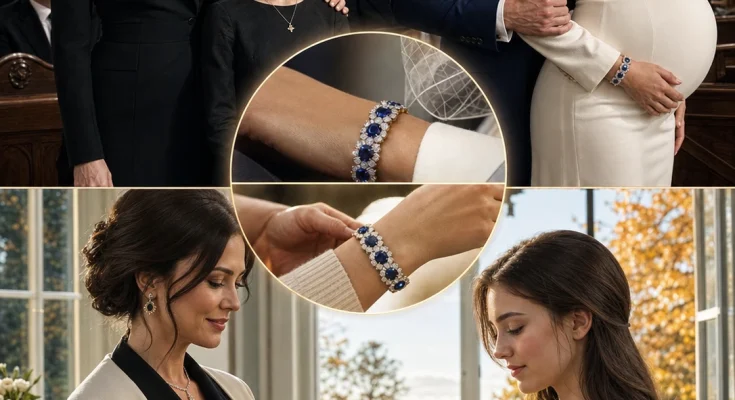
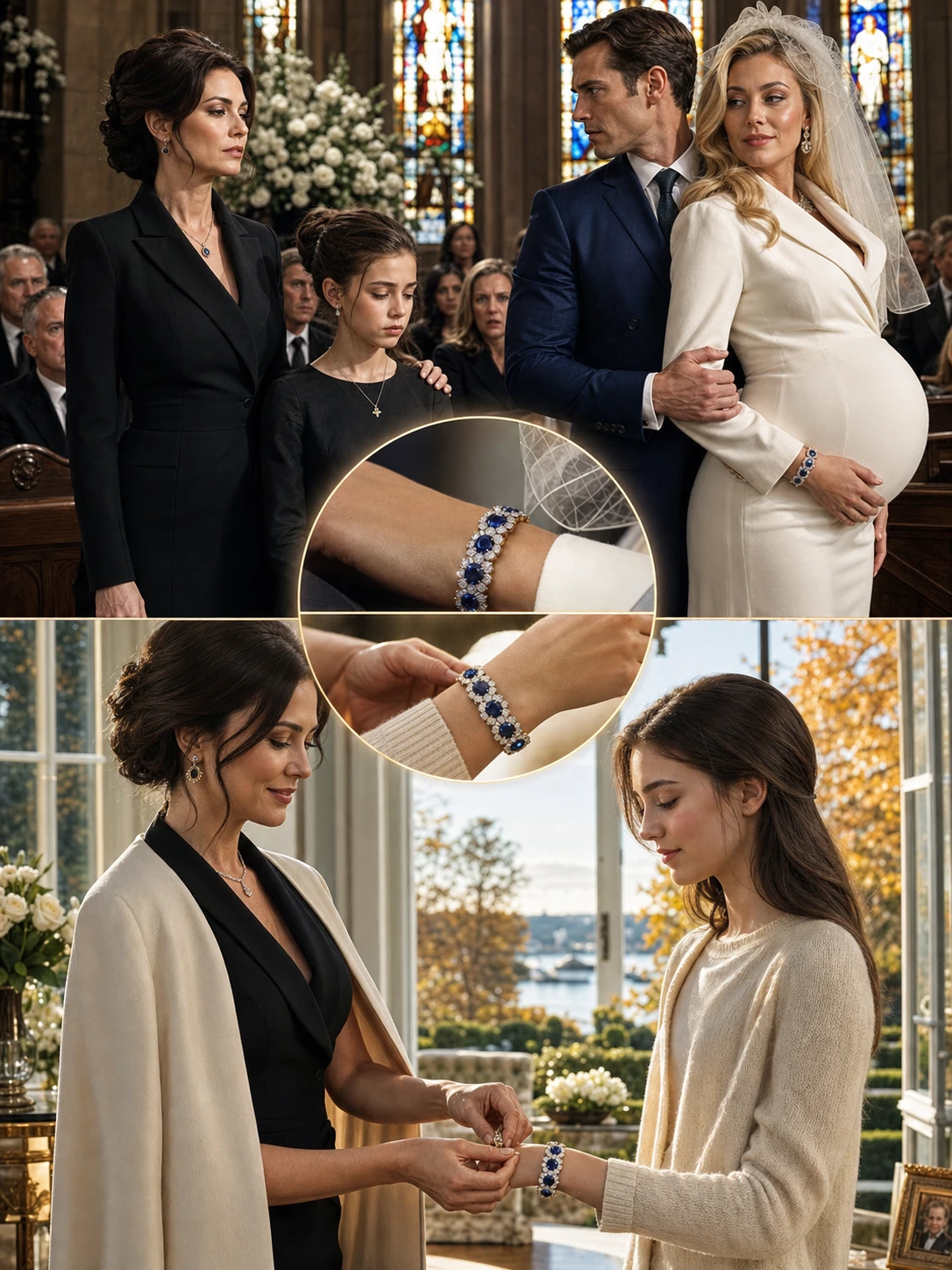
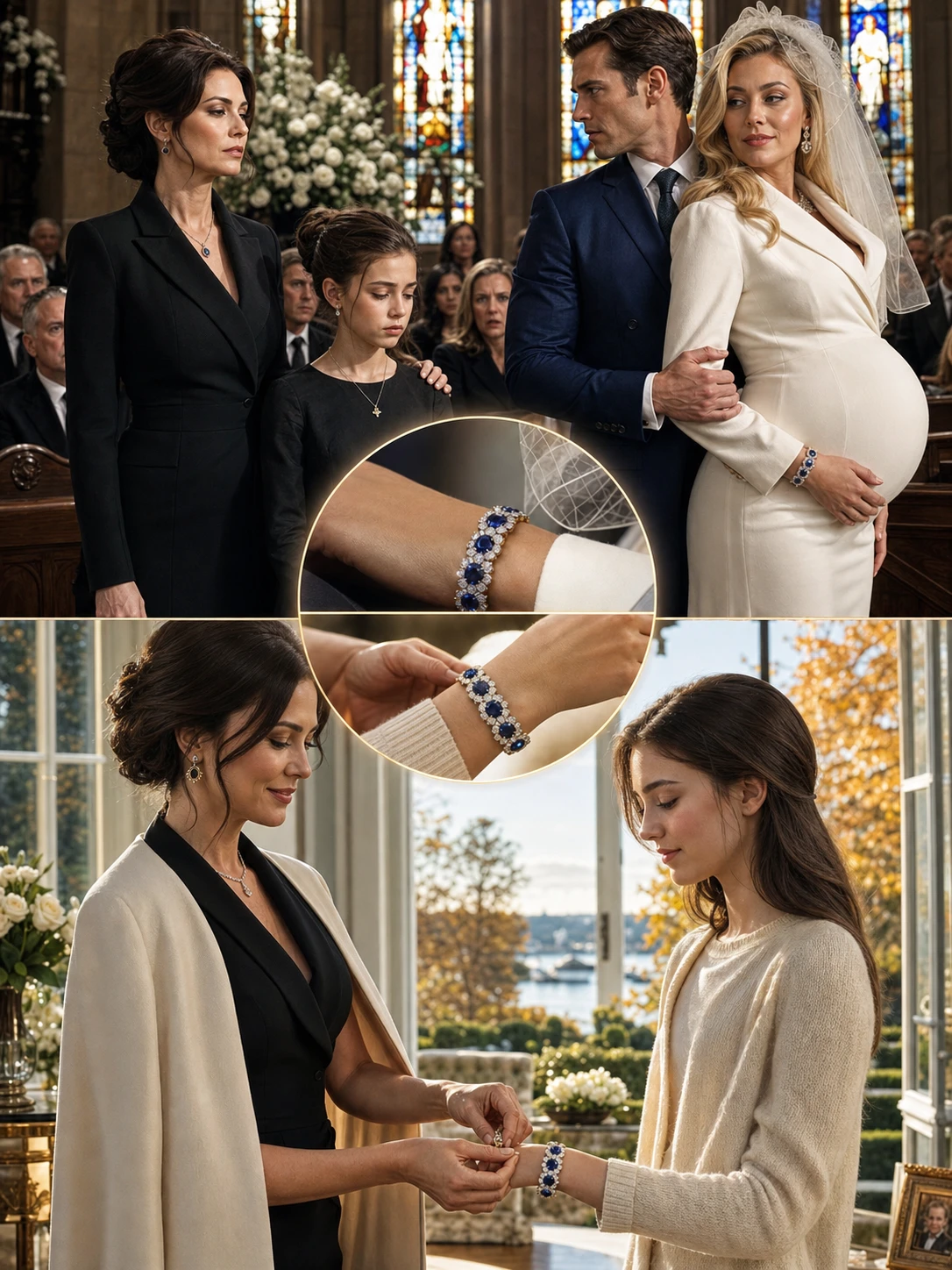
And on Sloane Hart’s wrist, glittering beneath the stained-glass light, was the sapphire bracelet my mother had promised to my daughter.
Preston leaned close enough for the cameras outside to catch the gesture and whispered, “Do not make a scene, Charlotte.”
His voice was soft, controlled, and cruel.
“The press is outside,” he said.
I looked at the coffin where Eleanor Whitmore lay beneath white roses, then at the woman wearing her jewelry like a trophy.
Then I smiled.
“I know,” I whispered back.
And I let the funeral director finish.
Part 1 — The Woman Who Dressed Like Victory
My mother used to say that rich families do not bury their dead.
They stage the grief, polish it, light it from the best angle, and invite everyone who once envied them to witness the performance.
That morning, Greenwich looked made for mourning.
Rain slid down the black windows of the chapel limousines, turning every headlight into a long silver wound.
The cemetery hills beyond Saint Bartholomew’s were blurred with fog, and the stone angels looked tired of keeping secrets.
I stood at the front of the chapel in a black dress my mother had chosen for me years before.
It was severe, sleeveless, and expensive in the quiet way that never needed a label.
My daughter, Grace, stood beside me with her hand tucked into mine.
At thirteen, she had my mother’s eyes, my father’s stubborn mouth, and the frightening stillness children develop when adults teach them too early that love can be conditional.
She had not cried yet.
Neither had I.
The Whitmore’s were famous for many things, but public collapse was not one of them.
My mother had built Whitmore House Hotels from one restored inn in Nantucket into a luxury empire that smelled of gardenias, brass keys, and five-star restraint.
She taught me how to sit in boardrooms before she taught me how to parallel park.
She taught me that silence could be a weapon if you held it long enough.
She did not teach me what to do when my husband arrived at her funeral with his pregnant mistress in bridal white.
But she had prepared for it anyway.
Preston Vale entered ten minutes before the service began.
He was handsome in a way that had always played well in photographs.
Dark hair brushed back from a clean forehead, jaw sharp enough for campaign posters, navy suit tailored so precisely it suggested virtue.
Beside him, Sloane Hart glowed.
That was the worst part.
She did not look ashamed.
She looked hydrated, highlighted, and victorious.
Her white coat dress clung softly over the small curve of her stomach, and a pillbox hat with a net veil shaded eyes painted to look innocent.
She rested one hand on Preston’s arm and the other on her belly, as if she had rehearsed the pose in front of a mirror.
Then she lifted her wrist.
Grace’s fingers tightened around mine.
“Mom,” she breathed.
I saw it.
The bracelet.
A circle of old platinum, set with oval sapphires and tiny diamonds, cold as winter dusk.
My mother had worn it every Christmas Eve, every foundation gala, every photograph in which she looked untouchable.
When Grace was six, she had sat on Eleanor’s lap and asked if princesses were allowed to wear blue stars on their wrists.
My mother had fastened the bracelet around Grace’s tiny hand and said, “When you turn sixteen, this will be yours.”
It had swallowed Grace’s wrist then.
Now it sat snug and smug on Sloane Hart’s arm.
Sloane moved down the aisle like she had been invited by God.
She paused at the second row to kiss my aunt Lydia on both cheeks.
“I’m Sloane,” she said, her voice just loud enough.
“Preston wanted me here because we are all going to be family soon.”
A sound moved through the chapel, not quite a gasp and not quite a laugh.
It was the sound people make when scandal enters wearing good tailoring.
My aunt stared at her as if she had found a snake in her purse.
Preston did not correct Sloane.
He guided her to the front pew.
My pew.
My mother’s pew.
The place reserved for immediate family.
Grace went very pale.
I leaned toward the usher and said, “The second row is appropriate for Mr. Vale.”
The young man froze because no one wants to be given a battlefield assignment at a funeral.
Preston smiled without warmth.
“Charlotte,” he murmured.
“Not today.”
“Exactly,” I said.
He lowered his mouth toward my ear.
The cameras outside had been waiting since dawn because my mother’s death was not just society news.
Eleanor Whitmore had been a philanthropist, a hotel magnate, a political donor, and the kind of woman newspapers called formidable when they wanted to avoid calling her dangerous.
Preston knew the headlines already.
Whitmore Heiress Breaks Down at Mother’s Funeral.
Estranged Wife Attacks Pregnant Girlfriend.
Vale Family Drama Overshadows Beloved Matriarch’s Farewell.
“Do not make a scene,” he whispered.
“The press is outside.”
He said it like a leash.
I looked at his hand on Sloane’s lower back.
That hand had worn my wedding ring for fourteen years.
That hand had signed birthday cards to our daughter, accepted my mother’s checks when his firm nearly collapsed, and slept warm against my ribs while his lies cooled between us.
“I heard you,” I said.
He studied my face, searching for cracks.
He had always hated that I did not break where he expected me to.
The funeral director approached the lectern.
The organ began its slow, aching hymn.
Everyone rose.
And I did nothing.
That was what frightened Preston most.
A woman who screams can be dismissed.
A woman who cries can be pitied.
A woman who stands perfectly still while her life is being burned in public makes everyone wonder what she knows.
The service was beautiful because my mother had planned beautiful things for strangers her entire life.
There were white roses from the governor.
There were orchids from the board of Whitmore House.
There was a letter from a senator, read by a man who had once begged my mother for money and now looked appropriately devastated that she could no longer write checks.
My brother, Miles, spoke first.
He was charming and useless, which in our world had always been enough to get him invited and never enough to get him trusted.
He cried when he mentioned our mother’s discipline.
That was fair.
Eleanor had loved him, but she had never confused love with confidence.
My aunt Lydia spoke next.
Then the minister.
Then me.
I walked to the lectern and placed both hands on the carved wood.
My mother’s coffin rested below me, covered in flowers so white they looked almost violent.
Behind the front pew, I could feel Sloane watching me.
I could feel Preston waiting for a tremor in my voice.
I looked at Grace.
She gave me a small nod.
So I delivered the eulogy I had written at three in the morning in my mother’s hospital room, while machines breathed in rhythm and lawyers came and went like priests of a colder religion.
“My mother believed elegance was not the absence of pain,” I said.
“She believed elegance was what remained when pain failed to make you smaller.”
Several women in the chapel lowered their eyes.
My voice stayed clear.
“She believed legacy was not jewelry, houses, hotels, or names on buildings.”
I paused.
“She believed legacy was protection.”
Preston shifted in the pew.
Good, I thought.
You heard it.
I finished without crying.
When I returned to my seat, Sloane smiled at me.
It was a tiny smile, polished at the edges.
She leaned forward as the minister gave the final blessing.
“She would have wanted peace,” Sloane whispered.
I turned my head slowly.
My daughter was close enough to hear every word.
Sloane’s eyes flicked to Grace, then to the bracelet, then back to me.
“It looks better with white, don’t you think?” she said.
Preston’s jaw tightened, but he did not stop her.
That was when the last piece of my marriage died.
Not with the affair.
Not with the pregnancy.
Not with the nights he came home smelling like another woman’s perfume and treated my suspicion like a mental defect.
It died because he let his mistress mock my daughter at my mother’s funeral while wearing a dead woman’s promise on her wrist.
The minister closed his Bible.
The funeral director stepped forward to guide us toward the recessional.
Outside, I heard the first burst of cameras as the chapel doors opened for staff.
I lifted one finger.
The funeral director stopped.
So did everyone else.
Preston’s face changed.
Not much.
Just enough.
A shadow behind the eyes, a calculation interrupted.
I looked to the side aisle where Elliott Crane, my mother’s attorney for thirty-two years, sat in the last row with a black leather folio on his lap.
Elliott was seventy, silver-haired, and gentle in the way a scalpel is gentle until someone puts pressure on it.
He stood.
“Before Mrs. Whitmore is taken from the chapel,” I said, “Mr. Crane will read a note my mother attached to a personal bequest.”
Sloane blinked.
Preston whispered, “Charlotte.”
I did not look at him.
Elliott walked to the front slowly, letting every shoe strike the marble with the weight of procedure.
He opened the folio.
“This memorandum was written by Eleanor Margaret Whitmore on April seventeenth of this year,” he said.
“It was witnessed by myself, Dr. Amelia Ross, and Ms. Dana Bell, head nurse at Greenwich Memorial Hospital.”
The chapel became so quiet I could hear the rain on the roof.
Elliott adjusted his glasses.
“The memorandum concerns one sapphire and diamond bracelet, platinum setting, appraised most recently at one hundred and eighty-seven thousand dollars, long known in the Whitmore family as the Vesper Bracelet.”
Sloane’s hand moved toward her wrist.
My mother had always loved dramatic timing.
Elliott continued.
“To my granddaughter, Grace Evelyn Whitmore Vale, I leave the Vesper Bracelet on the occasion of her sixteenth birthday.”
Grace inhaled sharply.
“If this bracelet is seen on any other woman before that date, understand that I did not give it.”
Sloane’s lips parted.
Preston went still beside her.
Elliott’s voice remained calm.
“If it appears on the wrist of Ms. Sloane Hart, understand that she is wearing not a gift, but evidence.”
The chapel erupted in whispers.
Aunt Lydia said, “Oh my God,” in the tone of a woman realizing brunch gossip had become litigation.
Sloane stood halfway, then sat when every eye turned to her.
Elliott turned the page.
“In March, I became aware of my son-in-law Preston Vale’s extramarital relationship with Ms. Hart.”
Preston rose.
“This is inappropriate,” he said.
His voice filled the chapel like a command.
No one moved.
Elliott looked at him.
“Mr. Vale, your objection is noted and irrelevant.”
There are moments in wealthy families when everyone remembers that money is not power.
Paper is power.
Signatures are power.
A lawyer with the right document can silence a room faster than grief.
Elliott read on.
“I also became aware that Ms. Hart had entered my daughter’s marital residence on at least five occasions while my daughter and granddaughter were away.”
Sloane’s face flushed beneath the veil.
“During one of those visits, the Vesper Bracelet was removed from my bedroom safe.”
My relatives turned toward Preston.
He looked at me as if I had betrayed him.
That almost made me laugh.
“I instructed Mr. Crane to preserve the security footage, inventory records, and correspondence concerning the bracelet, the affair, and any attempt to transfer Whitmore family assets outside the bloodline.”
Elliott lifted his eyes.
“The remaining materials are filed with the probate court and the Superior Court of Connecticut.”
Preston’s expression hardened.
This was no longer humiliation.
This was threat assessment.
Sloane clutched his sleeve.
“Preston,” she whispered.
But he was not looking at her anymore.
He was looking at me, finally understanding that the woman he had brought to my mother’s funeral was not the bomb.
She was the fuse.
Elliott closed the folio.
“Mrs. Whitmore’s final instruction regarding the bracelet was simple.”
He turned toward Grace.
“It was to be returned immediately to its rightful owner.”
Sloane stood fully now.
“This is insane,” she said.
Her voice shook, but her chin lifted.
“Preston told me Eleanor wanted me to have it.”
Every woman in that chapel heard the mistake.
She had called my mother Eleanor.
Not Mrs. Whitmore.
Not your mother.
Eleanor.
As if she had earned intimacy by trespassing through my life.
Grace stepped away from me.
She was small in her black dress, but she moved with my mother’s composure.
Preston reached out.
“Grace, don’t.”
My daughter looked at him.
He dropped his hand.
She walked to Sloane and held out her palm.
Sloane laughed once, brittle and ugly.
“I’m not handing over jewelry because a dead woman wrote a jealous note.”
Then Grace said the first words she had spoken since her grandmother died.
“You are wearing my inheritance to her funeral.”
Sloane’s mouth closed.
Grace did not raise her voice.
She did not cry.
She simply reached forward, touched the clasp, and opened it with the ease of a child who had watched her grandmother do it a hundred times.
The bracelet slid off Sloane’s wrist.
The sapphires caught the chapel light like blue fire.
My daughter removed the bracelet from the mistress’s wrist without saying a word.
And that was the moment every camera outside became useless.
Because the real photograph had already burned itself into every person inside that chapel.
Part 2 — The Prenup Beneath the Roses
Preston did not speak to me at the graveside.
He stood beneath a black umbrella beside Sloane, whose white coat had lost its power in the rain.
Without the bracelet, she looked less like a bride and more like a woman who had arrived at the wrong house and stolen the wrong thing.
The press shouted questions from behind the iron cemetery gates.
“Mr. Vale, who is the woman in white?”
“Mrs. Vale, are you separating?”
“Is it true Eleanor Whitmore changed her will before she died?”
Preston kept his hand on Sloane’s back, but the gesture had turned mechanical.
He was no longer comforting her.
He was managing optics.
I placed one white rose on my mother’s coffin as it descended.
Grace placed the bracelet on her own wrist for one second, just long enough for the sapphires to touch her skin.
Then she removed it, kissed it, and handed it to Elliott.
“Put it somewhere Dad can’t reach,” she said.
Elliott’s eyes softened.
“Of course.”
Preston heard her.
For a moment, pain crossed his face.
Then pride killed it.
At the reception, my mother’s mansion shone against the gray afternoon like a house too beautiful for honest people.
Whitmore Hall sat on twelve acres overlooking Long Island Sound, all limestone, black shutters, and windows tall enough to reflect storms as if they had been invited.
Inside, caterers moved silently with silver trays.
The mourners drank champagne because grief in our circle always came with bubbles.
I stood near the library fireplace while people offered condolences and avoided looking directly at my husband’s mistress.
Sloane had changed into black.
That insulted me more.
It meant she had owned black all along.
Preston approached after the governor left.
His smile remained fixed until we were alone between the library doors and the portrait of my grandfather.
Then it vanished.
“What the hell was that?” he said.
I looked at the portrait.
My grandfather had made his fortune selling imported marble to men who thought taste could be purchased by the slab.
“I believe it was called consequences,” I said.
Preston stepped closer.
“Do you have any idea what you did to me in there?”
“Yes.”
His eyes narrowed.
“You humiliated a pregnant woman at a funeral.”
“No,” I said.
“I allowed my mother’s lawyer to identify stolen property.”
His face hardened.
“Sloane did not steal it.”
“Then who opened my mother’s safe?”
His silence answered too quickly.
I turned to him.
“You gave her the code.”
He glanced toward the hall, where Sloane stood beside the flowers, pretending not to watch us.
“She admired the bracelet,” he said.
“I thought Mother had more compassion than you.”
It was an elegant lie, but he had grown lazy.
My mother had never allowed Preston to call her Mother.
Fourteen years of marriage, Christmas dinners, and board meetings, and she still corrected him with the same cool sentence.
“My name is Eleanor.”
I almost thanked him for the confession.
Instead, I said, “You should leave.”
His laugh was soft.
“This is my home too.”
“No, Preston.”
I faced him fully.
“It never was.”
His pupils sharpened.
There it was.
The fear beneath the cruelty.
When we married, Preston had been the golden son of a declining Boston family with a historic name, a bankrupt investment firm, and a smile that made older women reach for checkbooks.
I had been thirty, newly appointed to the Whitmore board, and foolish enough to believe charm was a form of intelligence.
My mother saw him clearly from the beginning.
She did not forbid the marriage.
That would have been too simple.
She handed me a prenup thick enough to stun a horse and said, “Love him as much as you like, Charlotte, but do not finance your own destruction.”
I signed.
Preston signed after three days of offended silence and one private meeting with his father.
He had smiled at the wedding like a man swallowing glass.
Then the years softened the memory of paper.
He forgot what he had signed because I never needed to use it.
Men like Preston mistake mercy for ignorance.
“They are my shares now,” he said.
His voice had dropped.
“I spent ten years building the Whitmore-Vale hospitality group while you hosted luncheons and played grieving daughter.”
I let that sit between us.
It was almost impressive how many lies he could fold into one sentence.
“You managed an expansion division funded by my mother’s private trust,” I said.
“You did not build the company.”
“You think a judge will see it that way?”
“No.”
I looked past him as Elliott entered the library.
“But Elliott will.”
Preston turned.
Elliott held another folio.
This one was burgundy.
The color of dried blood.
“I was hoping we might speak tomorrow,” Elliott said, “but given Mr. Vale’s misunderstanding, perhaps now is more efficient.”
Preston scoffed.
“At my mother-in-law’s reception?”
Elliott’s eyebrows rose.
“You brought your pregnant mistress to her funeral in white, Mr. Vale.”
Aunt Lydia, who had absolutely positioned herself within hearing distance, made a small choking sound behind her martini.
Elliott opened the folio.
“Charlotte, your mother executed several estate amendments during her final hospitalization.”
Preston’s jaw flexed.
“Hospitalization,” he said.
“You mean when she was medicated and dying.”
Elliott looked at him over his glasses.
“Dr. Ross certified Mrs. Whitmore competent on each date of execution.”
I remembered that hospital room.
The pale winter sun on the glass.
My mother’s wedding ring loose on her finger.
The oxygen tube beneath her nose.
Her voice, thinner than before but still edged with steel.
“Do not look so devastated, darling,” she had told me.
“Death is not the worst thing that can happen to a woman.”
I had tried to smile.
“What is?”
“Depending on the wrong man after you know he is wrong.”
At the time, I thought she was comforting me.
Now I knew she had been warning me.
Elliott turned a page.
“Your mother activated the Whitmore Preservation Trust, sometimes called the Grace Clause.”
Preston went pale.
I had never heard of it.
“What is that?” I asked.
“A contingency your mother established shortly after your wedding,” Elliott said.
“Quite privately.”
Preston tried to laugh.
“There is no clause that can simply take my company.”
“Your company?” Elliott asked.
The room seemed to lean toward him.
Elliott continued.
“The Whitmore family retained controlling voting shares through Eleanor Whitmore’s trust.”
“I run the company,” Preston said.
“You did,” Elliott replied.
“Conditionally.”
I watched Preston’s hands curl at his sides.
There is a specific kind of rage that appears in men who believe paperwork exists only to protect them.
“The condition,” Elliott said, “was that no spouse of Charlotte Whitmore Vale could use marital access, fiduciary authority, or family assets to undermine Charlotte, Grace, or the Whitmore bloodline.”
Sloane appeared in the doorway.
Her hand rested on her stomach.
She had stopped pretending not to listen.
Elliott did not spare her.
“Upon documented adultery, theft or misappropriation of family property, and attempted transfer of Whitmore assets to a nonmarital third party, Mr. Vale’s voting authority is suspended pending board review.”
Preston looked at me.
“You knew about this?”
“No,” I said.
That was the beautiful part.
My mother had not trusted my heartbreak to act quickly.
So she had built a trap that did not need me to be brave.
Sloane laughed.
It came out high and thin.
“This is disgusting.”
Everyone turned.
She walked into the library as if anger could restore status.
“You people act like blood makes you holy.”
“No,” I said.
“We act like theft makes you reckless.”
Her eyes flashed.
“Preston loves me.”
I looked at him.
He did not look at her.
The room noticed.
So did Sloane.
Her face tightened.
“He is leaving you,” she said.
“Fine.”
That single word shook her more than any scream could have.
She wanted a fight.
She wanted me cracked open, mascara ruined, voice sharp with begging.
Women like Sloane do not only want the husband.
They want evidence that the wife was destroyed by losing him.
But I had learned something in my mother’s hospital room.
The person who betrays you is rarely the prize.
They are often the invoice.
Preston took a step toward Elliott.
“You cannot remove me from the board with gossip and funeral theater.”
“No,” Elliott said.
“That is why Mrs. Whitmore gathered records.”
He removed a smaller envelope.
“Security footage from Whitmore Hall.”
Another.
“Emails sent from your office server.”
Another.
“Bank transfers from the marital account to Ms. Hart’s shell consulting firm.”
Sloane’s face changed.
Preston’s changed faster.
“Careful,” he said.
It was not advice.
It was a threat.
Elliott ignored him.
“And one more document Mrs. Whitmore requested that I preserve but not disclose unless Mr. Vale publicly presented Ms. Hart’s pregnancy as a family matter.”
Sloane’s hand fell from her stomach.
Preston said, “Enough.”
Elliott looked at me, not him.
“Charlotte, your mother wanted you to decide when to use that one.”
My heart beat once, hard.
“What is it?”
Preston moved toward the envelope.
Elliott stepped back.
“Mr. Vale.”
A security guard entered from the hall.
My mother’s security guard.
Not Preston’s.
His name was Marcus, and he had carried Grace on his shoulders when she was five.
Preston stopped.
The humiliation was quiet and total.
Elliott handed the envelope to me.
Inside was a sealed report from a prenatal paternity laboratory in New York.
My eyes moved over the words.
Names.
Dates.
Probability.
Exclusions.
For a moment, the room tilted.
Not because I was hurt.
Because I understood the size of the lie.
Sloane’s baby was not Preston’s.
And Preston knew.
Part 3 — The Gala Where the Crown Fell
Three weeks after the funeral, Preston filed for divorce.
He did it loudly.
His petition accused me of emotional cruelty, parental alienation, financial manipulation, and behavior unbecoming of a mother.
That phrase made my attorney laugh for the first time in ten days.
“Behavior unbecoming of a mother,” Elliott said, reading the filing in his office above Madison Avenue.
“He should have gone into fiction.”
The media ate it like cake.
By then, the funeral video had gone everywhere.
Not the legal note, of course.
No cameras had been inside the chapel.
But someone’s cousin had filmed Sloane arriving in white, one hand on her belly, bracelet blazing under the awning.
Another clip showed Grace leaving the chapel in black, dry-eyed, while Sloane rushed behind her with a bare wrist and a face like curdled milk.
The internet did what the internet does.
It crowned a villain before lunch.
Mistress Wore White became a headline, a hashtag, a joke, a costume concept, and a warning.
Preston claimed I had engineered the whole thing.
He gave an interview to a business magazine in which he described me as “cold under stress.”
That was supposed to hurt.
Instead, women sent me flowers.
Not roses.
White lilies, with cards that read, Stay cold.
Sloane posted a black-and-white photo of her hand over her stomach.
The caption said, Some families are chosen.
Grace saw it before I could stop her.
She sat at the kitchen island in our Manhattan townhouse, staring at her phone.
Then she said, “Dad chose someone else’s family.”
I took the phone gently from her hand.
“He chose himself.”
She looked up at me.
“Is there a difference?”
That broke something small and private in me.
I could survive my husband hating me.
I had not yet learned how to survive my daughter understanding him.
The temporary custody hearing was set for January.
Before that, there was the Whitmore Foundation Winter Gala.
My mother had created the gala twenty-six years earlier to fund hospital rooms for families who could not afford to stay near critically ill children.
The irony was not lost on me.
Preston wanted to attend.
His lawyers insisted that as acting CEO of Whitmore-Vale Hospitality, he had a professional obligation.
Elliott advised me not to block him.
“Let him stand in the room,” he said.
“Men like that reveal themselves best under chandeliers.”
The gala was held at the Whitmore Crown Hotel in Manhattan.
The ballroom had thirty-foot ceilings, mirrored columns, and views of the city glittering like a jewelry box with the lid left open.
My mother had loved that room.
She said it made wealthy donors more generous because nobody wanted to look cheap under a crystal chandelier.
I wore black velvet.
No necklace.
No wedding ring.
My hair was pinned low at my neck, and the Vesper Bracelet rested in a security vault two floors below, waiting for Grace’s sixteenth birthday.
Grace stayed home with my aunt Lydia, eating Thai takeout and pretending not to care about any of it.
I told her she did not have to watch adults embarrass themselves in formalwear.
She said, “Tell me if Sloane wears white again.”
“She won’t,” I said.
I was wrong.
Sloane arrived at nine.
The entire ballroom felt it.
Conversation thinned at the edges, then stopped.
She wore ivory satin, not white, because cowards love technicalities.
The dress skimmed over her pregnancy, and diamonds dripped from her ears.
Preston stood beside her in a tuxedo, smiling like the last three weeks had been a misunderstanding.
He had brought photographers.
Not press photographers.
His own.
That meant he wanted images he could control.
It also meant he had forgotten my mother founded the building we were standing in.
Every camera in that ballroom belonged to me before it belonged to him.
He crossed the room toward me, Sloane on his arm.
“Charlotte,” he said warmly.
For the audience.
“Preston,” I said.
For the record.
Sloane tilted her head.
“You look tired.”
“You look consistent.”
Her smile tightened.
Preston placed a hand on my elbow.
I looked down at it.
He removed it.
“We should speak privately,” he said.
“No.”
His eyes cooled.
“Then publicly is fine.”
He turned slightly, making sure the nearby donors and board members could hear.
“I came tonight to show unity, not hostility.”
“Of course.”
“We are still family,” he said.
Sloane looked pleased.
That sentence had been for her.
“We have a child together,” Preston continued.
“And soon, there will be another child connected to this family.”
There it was.
The lie in a tuxedo.
The room sharpened.
He wanted to force me to react.
He wanted headlines about my cruelty to his unborn child.
He wanted the board to see him as stable, generous, paternal.
A man expanding the family while his frigid wife guarded the gates.
I lifted a glass of sparkling water from a passing tray.
“How generous of you to include biology in your speech,” I said.
A few people laughed before they realized they were not sure whether they should.
Preston’s smile did not move.
“You know what I mean.”
“I do.”
Sloane placed a hand on her stomach.
“This baby deserves dignity.”
“Yes,” I said.
“Every baby does.”
For one second, she looked uncertain.
Then Preston stepped forward.
“I had hoped to avoid this tonight, but I think transparency matters.”
Elliott had been standing near the far wall with two board members and a judge’s widow who could ruin reputations with a sigh.
At Preston’s words, he looked at me.
I gave him the smallest nod.
Preston continued.
“Charlotte has been under extraordinary emotional strain, and while I have compassion for her grief, I cannot allow that grief to endanger the company my family helped build.”
My family helped build.
Not even an original lie.
The board chair, Margaret Bellamy, narrowed her eyes.
Preston raised his voice slightly.
“I will be asking the board to consider temporary executive authority until Charlotte receives the support she clearly needs.”
The ballroom was silent now.
Even the string quartet had faltered.
Sloane’s expression was radiant.
This was not spontaneous.
This was coronation.
He had brought her here to stand beside him while he declared me unstable in my mother’s ballroom.
He thought my silence was a weakness because it had protected him for years.
I set my glass on a tray.
“Are you finished?”
Preston gave me the sorrowful look he used for cameras.
“I wish you would not make this adversarial.”
“You brought your mistress to a charity gala three weeks after wearing her to my mother’s funeral,” I said.
“So I think we passed adversarial somewhere near the coat check.”
A sound rippled through the room.
Preston’s cheeks colored.
Good.
“Charlotte,” he warned.
I turned toward the stage.
“Ladies and gentlemen, before dinner, there is a brief foundation matter.”
The event manager saw me move and panicked professionally into action.
A microphone appeared.
The screens behind the stage lit up with the Whitmore Foundation crest.
Preston stepped toward me.
Elliott appeared at his side.
“Do not,” Elliott said.
The words were soft.
Preston stopped.
I walked onto the stage.
The ballroom lights found me.
In the first row, donors watched with the tense delight of people who had paid ten thousand dollars a plate and were about to receive entertainment for free.
“My mother founded this gala because she believed crisis reveals character,” I said.
“She also believed that some people only behave well when watched, so she built rooms with mirrors.”
A laugh moved through the room, nervous but real.
“Tonight, my husband has expressed concern about transparency.”
Preston stood near the stage, expression carved from stone.
“I share that concern.”
I clicked the remote in my hand.
The screen behind me changed.
Not to a photograph.
To a filing receipt from the Connecticut Superior Court.
A collective inhale moved through the ballroom.
“Earlier today, a petition was filed to suspend Preston Vale’s executive authority over Whitmore-Vale Hospitality pending investigation into breach of fiduciary duty, misappropriation of family assets, and violations of the Whitmore Preservation Trust.”
Preston’s voice cut through the room.
“This is a private marital matter.”
“No,” I said.
“Sleeping with your publicist was private until you billed her apartment to a corporate relocation account.”
Someone dropped a fork.
The screen changed again.
Wire transfers.
Dates.
Amounts.
Sloane Hart Consulting LLC.
A company formed two weeks after her first hotel assignment with Preston.
“I never touched company money,” Sloane snapped.
Her voice carried.
“No,” I said into the microphone.
“You invoiced it.”
The donors turned to look at her.
Sloane looked at Preston.
He was not looking at her.
He was looking at the screen, calculating which records I had and which records I had not shown.
I clicked again.
A photograph appeared.
Preston and Sloane entering Whitmore Hall through the garden entrance in March.
Timestamped.
Another photograph.
Sloane leaving with a velvet case under her coat.
The ballroom went utterly still.
“My mother preserved this footage before she died,” I said.
“She did not wish for spectacle, but she did wish for accuracy.”
I clicked once more.
This time, the screen remained black except for three lines of text.
Noninvasive prenatal paternity report.
Alleged father: Preston James Vale.
Conclusion: Excluded.
Sloane made a sound like the air had been punched from her body.
Preston’s face went white.
The room exploded.
Not loudly.
Worse.
Softly.
Rich people do not shout when scandal becomes undeniable.
They whisper, and whispers travel faster than sirens.
Sloane grabbed Preston’s arm.
“You said she would never use that.”
The microphone did not need to catch it.
Half the front row heard.
And half the front row was married to the other half of Manhattan.
I lowered the remote.
“I was not going to.”
My voice almost broke then, not from sorrow, but from rage held too long.
“Then he used my grief as a diagnosis.”
I looked at Preston.
“You called me unstable in the room my mother built.”
The chandeliers glittered above him like ice.
“You should have known she would still own the ceiling.”
Part 4 — The Courtroom With No Place to Hide
By the time we reached court, Preston had stopped smiling in photographs.
His lawyers tried to delay everything.
The divorce.
The custody petition.
The board review.
The probate disclosures.
Delay is a rich man’s favorite prayer.
Unfortunately for Preston, my mother had anticipated even his prayers.
Every document had copies.
Every copy had witnesses.
Every witness had been chosen by Eleanor Whitmore, which meant they were either loyal, terrified, or both.
The custody hearing took place on a February morning cold enough to make the courthouse steps shine with ice.
Grace wore a navy dress and a wool coat.
She looked too young for the building and too old for her age.
Before we went inside, she stopped me beneath the columns.
“Will I have to talk to him?”
“Only if the judge asks,” I said.
“I don’t want to hurt him.”
I touched her cheek.
“You are not responsible for making the truth painless.”
Her eyes filled, but she blinked the tears back.
That was the part I hated most.
She had inherited my composure before she had earned the right to softness.
Inside, Preston sat with his legal team.
Sloane was not there.
Her absence was its own testimony.
The tabloids said she had moved to Miami.
The blogs said the father of her child was a married venture capitalist from Palm Beach.
Elliott said nothing because good lawyers do not gossip where invoices can do the work.
Preston stood when we entered.
For one terrible second, I saw the man I had married.
The nervous groom at the altar in Newport.
The young father sleeping upright in a hospital chair after Grace was born.
The man who used to press his cold feet against mine under hotel sheets and tell me I was the only place he ever felt calm.
Then I remembered Sloane’s white dress.
I remembered Grace’s hand trembling in mine.
I remembered my mother’s bracelet on another woman’s wrist.
Memory is not mercy.
It is evidence.
The hearing began with Preston’s attorney describing me as controlled, emotionally withholding, and excessively influenced by my late mother.
He used the word “icy” twice.
Elliott wrote something on his legal pad and slid it to me.
It said, They always resent the weather they cannot change.
I almost smiled.
Preston’s side argued that Grace needed both parents.
That part was true.
Then they argued that I had orchestrated public humiliation to alienate Grace from her father.
That part was theater.
They presented photos from the funeral, edited articles, and clips of the gala without the financial documents.
They called my behavior “vengeful.”
Elliott stood slowly.
He had the patience of a man who had spent his life watching arrogant people confuse volume with proof.
“Your Honor,” he said, “Mrs. Vale did not expose Mr. Vale’s conduct to the child.”
He glanced at Preston.
“Mr. Vale brought the conduct to the funeral.”
The judge looked over her glasses.
She was a Black woman in her sixties with silver hair, a burgundy robe, and the expression of someone who had heard every lie in better grammar.
“Proceed,” she said.
Elliott presented the chapel witness list.
The seating arrangement.
The funeral program.
The note from my mother.
The security footage from Whitmore Hall.
The text messages.
Those were the ugliest.
Not because they were explicit.
Because they were casual.
Preston to Sloane, March 11:
She is in Nantucket with Grace.
Come through the garden entrance.
Preston to Sloane, March 18:
Take the bracelet if you want it.
The old woman never opens that safe anymore.
Preston to Sloane, April 2:
Charlotte won’t make a scene.
She was raised better than that.
I stared at those words until they blurred.
Not because they surprised me.
Because I could hear his voice in them.
Preston sat perfectly still.
His attorney whispered urgently.
The judge read in silence.
Elliott then entered the bank transfers, the shell company invoices, the board suspension order, and the paternity report Preston had received months before publicly referring to Sloane’s baby as “connected to this family.”
Preston’s lawyer objected.
The judge allowed it.
Then came the video.
I had not watched it before court.
Elliott had warned me.
“Your mother recorded it from her hospital room,” he said.
“She asked that it be played only if Preston challenged your stability or custody.”
The courtroom screen flickered.
My mother appeared against white pillows, thinner than she had been in life but not diminished.
Her hair was brushed back.
Her pearls rested at her throat.
The hospital machines blinked behind her like distant city lights.
For one second, I could not breathe.
Grace reached for my hand under the table.
On the screen, my mother looked directly into the camera.
“My name is Eleanor Margaret Whitmore,” she said.
“I am recording this statement on April twenty-first, in the presence of my attorney Elliott Crane and Dr. Amelia Ross.”
Her voice was fragile, but the authority remained.
“I wish to be clear about my daughter Charlotte.”
Preston looked down.
Coward, I thought.
Look at her.
“Charlotte is not unstable,” my mother said.
“She is disciplined.”
The judge watched without expression.
“She has endured more than she has revealed because she believed preserving her daughter’s peace mattered more than punishing her husband’s pride.”
My throat tightened.
Grace’s hand squeezed mine.
My mother continued.
“Preston Vale has benefited from that restraint.”
A pause.
“He has mistaken it for weakness.”
A sound left Preston then.
Not grief.
Not anger.
Something in between.
My mother’s eyes seemed to find him through the recording.
“If he ever attempts to use my daughter’s composure against her, let this statement stand as my answer.”
She leaned back slightly.
The nurse moved as if to stop the recording, but my mother lifted one finger.
She was not finished.
“To my granddaughter Grace,” she said.
Grace’s shoulders shook once.
“Darling, adults will try to make betrayal sound complicated when they are embarrassed by its simplicity.”
My mother’s mouth softened.
“Do not let anyone convince you that dignity means silence forever.”
A tear slid down Grace’s cheek.
She did not wipe it away.
“Dignity means choosing the moment when the truth will do the most good.”
The video ended.
The courtroom remained silent.
Even the judge looked down for a moment before making a note.
Preston’s lawyer asked for a recess.
The judge denied it.
When Preston took the stand, the polish was gone.
He admitted the affair but called it “an emotional refuge.”
He admitted bringing Sloane to the funeral but claimed she had been invited to support him.
He admitted giving her the bracelet but said he believed Eleanor intended to accept her.
At that, Elliott rose.
“Mr. Vale, are you saying Eleanor Whitmore gave her blessing to your mistress while your wife was sitting at her hospital bedside?”
Preston swallowed.
“I am saying Eleanor understood families are complicated.”
“No,” Elliott said.
“I asked whether she gave permission.”
Preston did not answer.
Elliott approached the witness stand.
“Did you know the Vesper Bracelet had been promised to Grace?”
“Yes.”
“Did you know Ms. Hart was not pregnant with your child?”
Preston’s jaw tightened.
“Yes.”
Grace’s hand went cold in mine.
There it was.
Not rumor.
Not report.
Confession.
“And yet you brought Ms. Hart to Mrs. Whitmore’s funeral wearing Grace’s bracelet, allowed her to introduce herself as a future family member, and later described her pregnancy publicly as connected to the Whitmore family?”
Preston closed his eyes.
“Yes.”
“Why?”
The courtroom seemed to hold its breath.
Preston opened his eyes and looked at me.
For once, he did not perform.
For once, he told the truth because he had nowhere left to hide it.
“Because Charlotte never fights in public,” he said.
“She just stands there.”
Elliott waited.
Preston’s voice dropped.
“I thought if I made it real enough, she would accept it.”
There are sentences that end marriages more completely than affairs.
That was one.
The judge ordered temporary primary custody to me, with supervised visitation for Preston pending family therapy and further review.
She cited his public conduct, manipulation of family events, and willingness to involve Grace in adult humiliation.
Preston looked at Grace when the order was read.
She did not look back.
Not out of cruelty.
Out of survival.
The divorce settlement took longer, but the direction had been set.
The prenup held.
The Whitmore Preservation Trust held.
Preston’s voting authority was revoked.
The board removed him as CEO after an internal investigation discovered that Sloane Hart Consulting had received seven hundred and forty thousand dollars in questionable payments over eighteen months.
Preston resigned before they could fire him, which allowed the papers to use gentler words.
But everyone understood.
He had not lost because he fell in love with another woman.
He lost because he tried to turn my family’s legacy into a stage for my humiliation.
Sloane gave birth in April.
The father was not Preston.
It was not the venture capitalist either.
That was the kind of detail the internet enjoyed too much and I refused to repeat in my own home.
Grace asked once if the baby was okay.
I said yes.
She nodded.
“Good,” she said.
Then she went back to her homework.
That was the first time I believed she might become kinder than all of us.
Part 5 — The House My Mother Left Behind
Spring came back to Greenwich without asking permission.
The dogwoods opened along the drive at Whitmore Hall, pale and stubborn against the rain.
For months after court, I could not enter my mother’s bedroom.
Not because of ghosts.
Because of absence.
Her robe still hung behind the door.
Her reading glasses sat on the table beside a novel she had pretended not to enjoy.
The safe had been repaired, recoded, and moved behind a portrait of my grandmother, who looked in oils as though she would personally bite anyone who tried another theft.
Grace began spending Saturdays at the house with me.
At first, we sorted things like archaeologists.
Gloves.
Letters.
Photographs.
Receipts from hotels that no longer existed.
My mother had kept everything.
A reservation card from the first Whitmore Inn.
A pressed flower from my wedding bouquet.
A drawing Grace had made at age four of three women holding hands beneath a blue moon.
On the back, my mother had written, My girls.
I found it in a drawer with tax documents and cried so suddenly that Grace froze.
She had seen me angry.
She had seen me composed.
She had seen me in court with my spine straight enough to make men careful.
She had rarely seen me fold.
“Mom?” she whispered.
I sat on the floor of my mother’s dressing room, holding the drawing.
“I’m all right.”
“No, you’re not.”
I almost corrected her.
Then I stopped.
She deserved better than inherited lies.
“No,” I said.
“I’m not.”
Grace sat beside me.
After a moment, she leaned her head against my shoulder.
We stayed like that between cedar drawers and boxes of silk scarves while afternoon light moved across the carpet.
That was how healing began.
Not with victory.
Not with headlines.
With my daughter learning that dignity did not require me to be made of marble.
By June, I had taken over as chair of Whitmore House.
The first board meeting without Preston felt less triumphant than clean.
His chair had been removed.
Not left empty.
Removed.
Margaret Bellamy opened the meeting by saying, “Eleanor would have enjoyed this.”
I said, “She would have pretended not to.”
Everyone laughed.
The company survived because companies almost always survive men who think they are irreplaceable.
We restructured the division Preston had mismanaged.
We shut down the contracts tied to Sloane’s shell company.
We established an ethics committee, which made my mother’s portrait in the lobby look amused.
The press eventually found new scandals.
It always does.
But strangers still sent messages.
Women told me about husbands who introduced girlfriends as assistants.
Mothers-in-law who smiled through theft.
Daughters who watched fathers rewrite the family story and call the edit love.
Some wrote only two words.
Stay cold.
I wrote back when I could.
Stay free.
Preston’s visits with Grace began in a therapist’s office in Stamford.
The first one lasted twenty-three minutes.
Grace came home quiet.
I made pasta because grief and carbohydrates have an ancient treaty.
She twirled spaghetti around her fork for a long time before speaking.
“He apologized,” she said.
“How did that feel?”
She considered.
“Like he wanted it to count as fixing it.”
I nodded.
“That can happen.”
“He asked if I hated him.”
“What did you say?”
“I said I’m thirteen, and he should ask me something fair.”
I looked at her across the kitchen island.
Then I laughed.
Not loudly.
But honestly.
Grace smiled a little.
It was the first unguarded smile I had seen from her in months.
Preston wrote letters after that.
Some were good.
Some were performances.
Grace read them when she wanted and ignored them when she wanted.
I did not push forgiveness.
Forgiveness offered too early can become another room where women are asked to behave.
That summer, we returned to Nantucket.
My mother’s first inn still stood on a narrow street lined with hydrangeas and bicycles.
It had twelve rooms, uneven floors, and brass keys she refused to replace with key cards.
“The locks have more character than most men,” she once told a hotel consultant, ending the meeting with one sentence.
Grace and I stayed in the owner’s suite above the garden.
At night, the sea air moved through the curtains, and the old building creaked like a ship.
One morning, Grace found me in the tiny office where my mother had signed her first loan agreement.
On the wall hung a black-and-white photograph of Eleanor at thirty-two, standing in front of the inn with paint on her sleeve and defiance in her smile.
“She looks like you,” Grace said.
“I used to think I looked like her.”
“What’s the difference?”
I looked at the photograph.
“At some point, you stop trying to inherit someone’s strength and start admitting you have your own.”
Grace leaned against the desk.
“Do you miss Dad?”
The question landed gently, which made it harder.
“I miss who I thought he was,” I said.
“I miss our family before I knew it was breakable.”
She nodded.
“Me too.”
We sat with that truth.
No fixing.
No speeches.
Just the ocean outside and a photograph of a woman who had known how to leave traps for monsters and love letters for the people she was protecting.
In September, the final divorce decree arrived.
The marriage ended on paper in a conference room with gray carpet and bad coffee.
Preston signed first.
His hair had more gray at the temples.
He looked tired in a way charm could not renovate.
When the pen reached me, I expected to feel something cinematic.
A swell of music.
A flashback.
A wound closing.
Instead, I felt the mild annoyance of signing a hotel invoice with the wrong room number.
Fourteen years ended in blue ink.
Preston looked at me after the lawyers gathered the papers.
“Charlotte.”
I paused.
He seemed smaller without an audience.
“I loved you,” he said.
Maybe he had.
Maybe he loved me in the way some men love houses, as long as the lights are on, the rooms are clean, and the doors open when they arrive.
“I loved you too,” I said.
His eyes flickered.
Then I added, “That is not a defense.”
He looked away.
Outside, Manhattan moved on without caring.
That was one of the city’s few kindnesses.
The following winter, Whitmore Foundation reopened the family wing at Greenwich Memorial Hospital.
My mother’s name was carved into a wall of pale stone near the entrance.
Eleanor M. Whitmore Family Residence.
For families who need to stay close.
Grace stood beside me at the dedication in a navy coat, her hair pinned back, the Vesper Bracelet still locked away because she was not sixteen yet and rules mattered more after people tried to break them.
The hospital room where my mother recorded the video had been renovated.
New paint.
New monitors.
A small couch that folded into a bed.
A window overlooking the courtyard.
I stood there alone after the ceremony.
The room smelled of fresh linen and antiseptic.
For months, I had remembered it only as the place where my mother died.
Now it held a crib near the window and a child’s drawing taped to the wall by some other family surviving some other night.
I touched the windowsill.
“You were right,” I whispered.
About Preston.
About silence.
About protection.
About me.
My phone buzzed.
A message from Grace.
Are you hiding in Grandma’s room?
I smiled.
Yes.
She replied.
Come downstairs.
There is cake and Aunt Lydia is flirting with the mayor.
That sounded like life.
Messy, inappropriate, and still happening.
I went downstairs.
Conclusion — The Bracelet Under the Morning Light
Grace turned sixteen on a clear October morning.
The sky over Greenwich was the kind of blue my mother would have called expensive.
We did not throw a ballroom party.
Grace asked for breakfast at home, a chocolate cake from a bakery in SoHo, and no speeches that made her “feel like a museum exhibit.”
Aunt Lydia came with flowers.
Miles came late with an absurdly large gift and the expression of a man hoping punctuality was not genetic.
Elliott came with the bracelet.
He carried it in the original velvet case, restored, polished, and documented within an inch of its life.
We gathered in my mother’s sunroom at Whitmore Hall, where the windows looked out over the water and the floor still bore faint scratches from Grace’s childhood dance recitals.
Grace wore a simple cream sweater and jeans.
No makeup.
No performance.
She looked like herself.
That felt like the greatest victory of all.
Elliott opened the case.
The sapphires flashed in the morning light.
For a moment, none of us spoke.
Then Grace looked at me.
“Will you put it on?”
My hands were steady as I lifted the bracelet.
It was heavier than I remembered.
Not because of the diamonds.
Because of everything it had carried.
My mother’s wrist at Christmas.
Sloane’s wrist in the chapel.
Grace’s small hand reaching out in black sleeves.
A courtroom screen.
A hospital room.
A family breaking.
A family becoming honest.
I fastened the clasp around my daughter’s wrist.
This time, it fit.
Grace looked down at it, then up at the portrait of my mother above the fireplace.
“I wish she were here,” she said.
“She is,” Aunt Lydia replied immediately, wiping her eyes with a cocktail napkin despite the hour being ten in the morning.
“She would just be criticizing the coffee.”
We laughed.
And because the house had heard enough whispers, it seemed grateful for the sound.
Later, after everyone left, Grace and I walked through the garden.
The air smelled of leaves, salt, and rain coming from somewhere far away.
She wore the bracelet under the sleeve of her sweater, not showing it off, not hiding it either.
“Do you think people can change?” she asked.
I knew she meant Preston.
I knew she also meant herself.
“Yes,” I said.
“But change is not a speech.”
“What is it?”
“Pattern,” I said.
“Proof over time.”
She nodded like she would remember that.
At the end of the garden path, the chapel bells rang in the distance.
Not for a funeral this time.
A wedding, maybe.
Or a baptism.
Some other family beginning a story they believed they could control.
Grace slipped her hand into mine.
For a second, I saw us from far away.
A woman in black no longer mourning herself.
A girl with sapphires on her wrist.
A house behind us, no longer haunted by what happened inside it, but steadied by what survived.
My mother once told me elegance was what remained when pain failed to make you smaller.
I did not understand then.
I do now.
Elegance was not the dress.
Not the bracelet.
Not the silence.
It was walking out of the chapel without begging.
It was telling the truth under chandeliers.
It was letting my daughter see me cry on the floor and rise again without apologizing for either.
It was learning that betrayal can strip a life down to bone, but it cannot decide what grows back.
That morning, under a blue Connecticut sky, Grace lifted her wrist and watched the sapphires catch the sun.
“They look like stars,” she said.
I smiled.
“They always did.”
And for the first time in a long time, the light did not feel like exposure.
It felt like home.