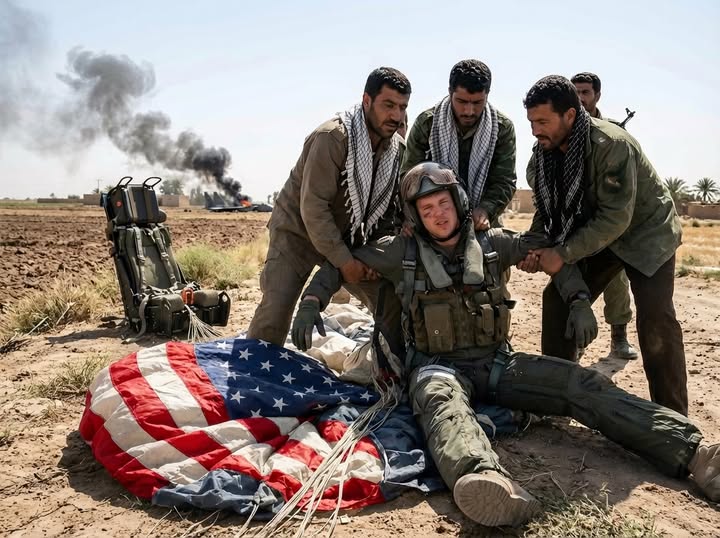
The video spread fast—shared across TikTok, reposted on X, and debated in comment sections worldwide. Grainy footage showed a man surrounded by people, with captions claiming something dramatic: an American pilot had been captured alive by Iranian civilians after his jet was shot down.
Within hours, it became more than just a clip. It became a story people wanted to believe.
But was it real?
It all began during the escalating tensions of the 2026 Iran conflict, when reports confirmed that a U.S. fighter jet had indeed been shot down over Iran. Two crew members ejected, triggering a high-stakes rescue operation deep inside hostile territory.
That part was real.
What happened next, however, became a mix of fact, fear, and online speculation.
Iranian state-linked media quickly claimed that one of the pilots had been captured.
At the same time, reports suggested that civilians were being encouraged to locate the missing airman, even with incentives offered for capture.
That’s when the video appeared.
In the clip, a man—disoriented, surrounded, possibly restrained—was presented as proof. The captions were confident. The tone was urgent. And for many viewers, it felt believable enough.
But there was one problem:
No one could verify it.
Fact-checkers soon stepped in. Investigations into the footage revealed a crucial detail—the video itself was real, but the claim attached to it was misleading. It did not show an American pilot being captured in Iran.
In other words, the internet had done what it often does during moments of crisis: it filled in the gaps with assumption.
Meanwhile, actual developments on the ground told a different story.
U.S. forces were actively searching for the missing crew members, conducting what officials described as a complex and dangerous rescue mission.
One aviator was recovered quickly. The other evaded capture for days in rugged terrain before also being successfully rescued in a dramatic operation involving helicopters, special forces, and air support.
Despite Iranian claims and online rumors, there was no confirmed evidence that any American pilot had been captured and held by civilians.
So why did the story spread so widely?
Because it fit the moment.
During wartime, information moves fast—but not always accurately. Both sides in the conflict have been accused of spreading misleading or manipulated content to shape public perception.
In that environment, a short video can become a powerful narrative tool. A few seconds of unclear footage, paired with a strong claim, can travel faster than verified facts ever could.
And once people start sharing, questioning often comes later—if at all.
In the end, the viral video became a lesson.
Not about a captured pilot—but about how easily reality can be distorted in real time.
Yes, a U.S. jet was shot down.
Yes, there was a missing pilot.
Yes, tensions were—and still are—extremely high.
But the image of an American pilot captured by civilians?
As of now, it remains just that:
An unverified rumor, amplified by the speed—and sometimes the recklessness—of the internet.